Last updated: September 18, 2026
A certificate of insurance tells you a subcontractor has coverage. An additional insured endorsement tells you that coverage extends to you.
Those are not the same thing.
Anyone who has been through a claim knows the difference. The certificate shows up clean. The carrier still denies the tender. The reason, almost every time, comes down to the endorsement: what it says, which form was used, and whether it matches what the contract required.
This post breaks down what additional insured endorsements are, which ISO forms matter, and where compliance programs get it wrong.
What "additional insured" actually means
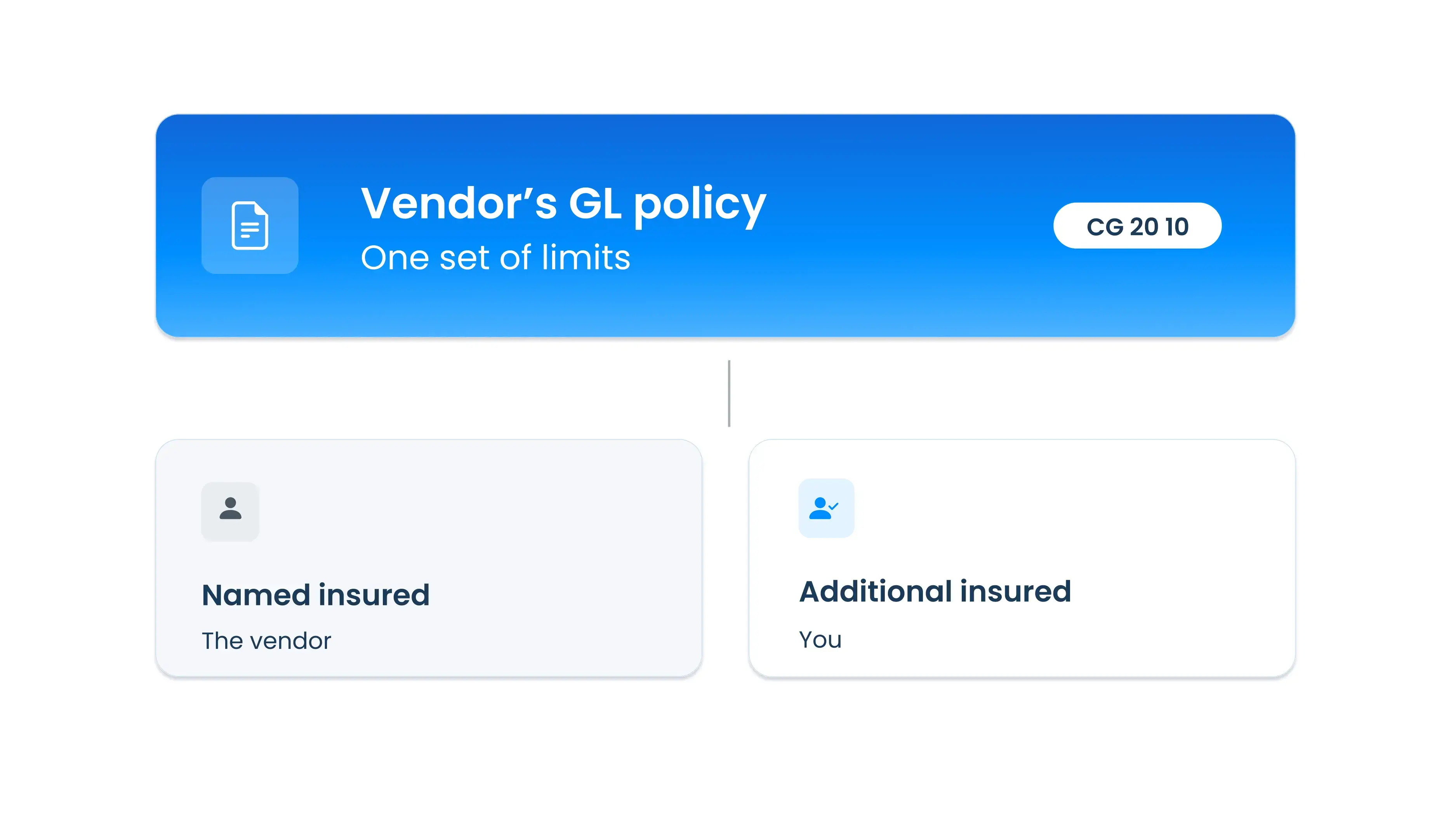
When a vendor, contractor, or service provider names you as an additional insured on their general liability policy, you get direct standing to make a claim under their policy. You are treated as an insured for covered claims arising from their work.
This matters when a worker gets hurt on your property, an owner sues the hiring party, or a completed project develops a problem tied to a vendor's scope. Without additional insured status, your only path to recovery runs through the indemnification obligation in the contract, which depends on the other party's financial position and the enforceability of that clause.
With additional insured status, you go directly to the carrier.
That protection is only as strong as the endorsement. A certificate that says "additional insured" without the right form attached is a promise the carrier never agreed to.
Why the ISO form number matters
ISO (Insurance Services Office) publishes standardized policy forms that most commercial general liability carriers use. When a carrier adds you as an additional insured, they attach a specific endorsement form to the policy. The form number tells you exactly what coverage you are getting.
Forms vary significantly. Some cover ongoing operations only. Some cover completed operations. Some limit coverage to vicarious liability. Some require the injury to be caused solely by the named insured's acts. These differences determine whether a claim gets paid.
Contracts should specify the required form numbers, not just "additional insured status."
The three forms to know
CG 20 10 -- Additional Insured, Ongoing Operations
CG 20 10 covers additional insured status for liability arising out of the named insured's ongoing operations. In plain terms: while the vendor or contractor is actively working.
This form is standard and widely used. Most vendors can provide it without friction. The issue is that coverage stops when the work stops. If a completed project develops a problem six months after a contractor finishes, CG 20 10 provides no protection.
Require this form for active coverage. Do not rely on it alone.
CG 20 37 -- Additional Insured, Completed Operations
CG 20 37 extends additional insured status to liability arising from completed work. This is the form that covers you after the project or engagement closes.
Construction defect claims, completed work injuries, and post-project property damage all fall into this category. These claims tend to be larger and harder to defend, and they often surface years after the work ended. CG 20 37 is where that protection lives.
Requiring both CG 20 10 and CG 20 37 is the baseline for most risk programs.
CG D3 81 09 15 -- Blanket Additional Insured (Ongoing and Completed)
This is a single endorsement form that provides both ongoing and completed operations coverage in one attachment. Some carriers issue it as an alternative to providing CG 20 10 and CG 20 37 separately.
The coverage result is similar. The advantage is one form to collect and verify. The disadvantage is that not all carriers use it, so you cannot universally specify it as a substitute.
When a vendor provides CG D3 81 09 15, confirm it covers completed operations before accepting it in place of CG 20 37.
What to look for in the endorsement language
For ongoing operations (CG 20 10 or equivalent): confirm the Schedule names your organization or states "As Required by Written Contract," the endorsement covers bodily injury and property damage arising from the vendor's ongoing operations at your location, and coverage limits match your contract requirements.
For completed operations (CG 20 37 or equivalent): confirm the same three items above, plus verify the language specifically references "your work" included in the "products-completed operations hazard." An endorsement that only references ongoing operations does not cover completed work claims even if the form number appears correct.
For blanket endorsements covering both: confirm the language explicitly addresses both ongoing and completed operations. Some blanket forms are limited to ongoing operations only despite appearing broader.
COI tracking software automates the verification of additional insured requirements across your entire vendor or subcontractor list.
Where compliance programs get this wrong
Accepting the certificate as proof
The ACORD 25 has a checkbox for additional insured status. That checkbox means a certificate holder requested the notation. It does not confirm the endorsement exists on the policy. The only thing that confirms the endorsement is the endorsement itself.
Most COI programs collect the certificate and stop. The endorsement is never requested, never collected, or never reviewed against contract requirements.
Not specifying the form in the contract
Contracts that require additional insured status without specifying form numbers leave the decision to the vendor's broker. Brokers tend to attach whatever is easiest to issue, which is often a more restrictive form than the contract intended.
Specify CG 20 10 and CG 20 37 by form number. Put it in every contract. Your insurance and legal teams should sign off on the language.
Not tracking completed operations separately
Ongoing operations endorsements expire when the work closes. Completed operations endorsements need to stay active for the tail period defined in the contract, which can often be two to five years or even longer for design-build or public projects.
If your compliance program is not tracking completed operations endorsements through the tail period, the gap is invisible until a claim surfaces on a closed project.
For how to track completed operations endorsements through the renewal cycle, see How to Manage COI Renewals Without Chasing Vendors.
Accepting blanket endorsements without reviewing wording
Some carriers issue blanket additional insured endorsements that cover any party required by contract. These can be valid, but the wording varies. Some are limited to ongoing operations. Some include anti-indemnity carve-outs tied to your own negligence. Review the form, not just the form number.
What to do with this in practice
Your contracts should specify:
- CG 20 10 for ongoing operations
- CG 20 37 for completed operations, with the required tail period
- Primary and non-contributory language (see Primary and Non-Contributory: What It Means and Why It Matters)
- Waiver of subrogation (see Waiver of Subrogation: What It Is and Why Contracts Require It)
Your COI program should:
- Collect endorsements alongside certificates
- Verify the form number matches what the contract required
- Track completed operations endorsements through the tail period
- Flag substitutions and blanket forms for manual review
A certificate without the endorsement is a placeholder. The endorsement is the coverage.
How PINS verifies additional insured endorsements
The certificate alone does not confirm whether the additional insured endorsement meets your specs. PINS collects endorsement documents alongside certificates and checks the language, flagging wrong form numbers, missing completed operations coverage, or blanket endorsements that do not qualify under your contract terms.
Your team reviews the findings and makes the final decision. The gaps are harder to miss when the reasoning is surfaced for you.
If your current process stops at the certificate, the endorsement wording is not being verified.
COI tracking software built around endorsement review catches what certificate-only processes miss. See how the PINS AI Assistant handles the review in practice.
Evaluating your options? See how PINS compares to other COI tracking software.
Frequently asked questions
What is the difference between CG 20 10 and CG 20 37?
CG 20 10 covers additional insured status while the vendor or contractor is actively working. CG 20 37 extends that coverage to liability arising after the work is complete. Most risk programs require both -- CG 20 10 for active project protection and CG 20 37 for the tail period after the project closes.
Does a certificate of insurance prove additional insured status?
No. The ACORD 25 has a checkbox for additional insured status, but a checked box only confirms the certificate holder requested the notation. The only confirmation that an additional insured endorsement exists on the policy is the endorsement itself. Collect and review the endorsement, not just the certificate.
What happens if a subcontractor provides the wrong endorsement form?
If the form does not match what the contract requires, the coverage may be narrower than intended. A broker may attach a more restrictive form by default if the contract does not specify form numbers. That is why contracts should require CG 20 10 and CG 20 37 by form number, not just "additional insured status."
How long does a completed operations endorsement need to stay active?
The tail period is defined in the contract, not the endorsement. Most programs require two to five years after project completion. Design-build and public projects often require longer. Track completed operations endorsements separately from active project COIs and verify they remain in force through the full tail period.
Can a blanket additional insured endorsement substitute for CG 20 10 and CG 20 37?
Sometimes. Blanket endorsements that explicitly cover both ongoing and completed operations can be acceptable. The wording varies significantly between carriers, and some blanket forms are limited to ongoing operations only or include carve-outs that reduce the coverage. Review the endorsement language, not just the form type.