Last updated: September 18, 2026
Additional insured status gets you onto a vendor's policy. Primary and non-contributory language determines how that policy responds when a claim hits.
Without it, you may have additional insured status and still end up sharing the loss with your own carrier.
What the terms mean
These are two separate concepts that almost always travel together in contract language.
Primary
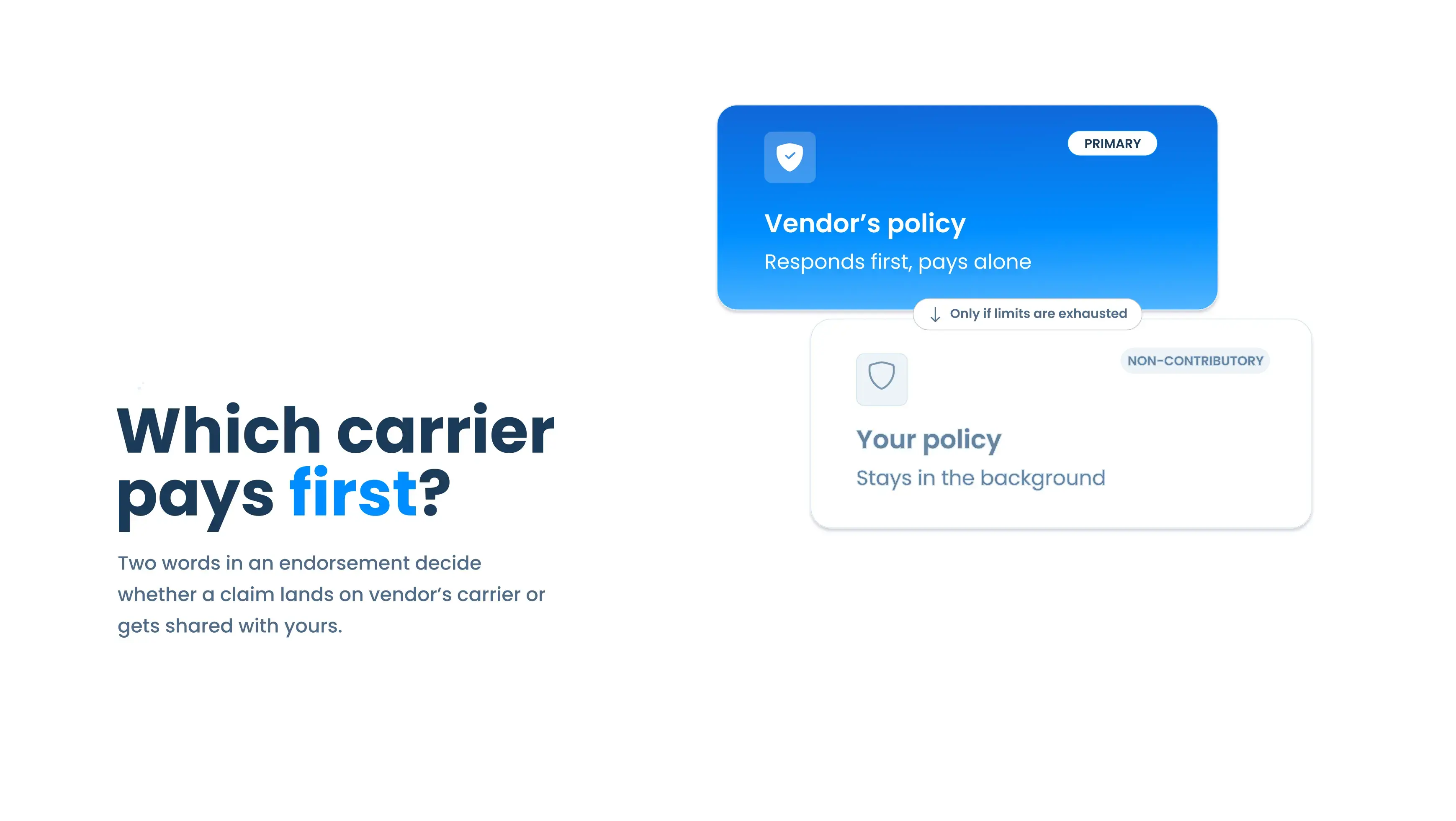
When a vendor's policy is designated as primary, it responds first to a covered claim before any other insurance applies. Your policy sits in the background. The vendor's carrier handles the claim, pays up to its limits, and your policy only comes into play if the loss exceeds those limits.
Without primary language, carriers can argue about which policy should respond first. That argument takes time, costs money, and can leave you managing a claim that should have gone directly to the vendor's carrier.
Non-contributory
Non-contributory means the vendor's carrier cannot require your policy to share in the loss. Without this language, a carrier can invoke "other insurance" clauses and demand that your policy contribute to the payment proportionally.
This combination, primary and non-contributory, means the vendor's policy goes first and goes alone. Your policy is not pulled in until the vendor's limits are exhausted.
Why this matters in practice
Consider a straightforward scenario: a subcontractor's employee is injured on your project. You are named as an additional insured on the sub's GL policy. A claim is filed.
If the sub's policy does not include primary and non-contributory language, the sub's carrier may look at your GL policy and invoke the other insurance clause. Your carrier gets pulled into the claim. Your loss runs experience is affected. Your premiums increase.
With primary and non-contributory language in place, the sub's carrier handles the claim. Your policy stays out of it unless the loss exceeds the sub's limits.
Across dozens or hundreds of vendors and contractors the difference in premium impact and claims management burden is significant.
If your contracts require primary and non-contributory coverage, COI tracking software removes the manual work of verifying that requirement across every subcontractor.
Where it lives in the policy
Primary and non-contributory status is not automatic. It has to be endorsed onto the vendor's policy. The most common endorsement form is the CG 20 01 (Additional Insured Primary and Non-Contributory), though carriers may use proprietary forms with equivalent language.
Like additional insured endorsements, this cannot be confirmed from the certificate alone. The ACORD 25 has a checkbox for primary and non-contributory, but a checked box only means the certificate holder requested the notation. The endorsement on the policy is the only confirmation.
What the endorsement language should say
When you receive an endorsement from a vendor's broker, the language confirming primary and non-contributory status should explicitly state both terms. Standard ISO language on a CG 20 01 or equivalent form typically reads:
"This insurance is primary to and will not seek contribution from any other insurance available to an additional insured under your policy provided that: (1) The additional insured is a Named Insured under such other insurance; and (2) You have agreed in writing in a contract or agreement that this insurance would be primary and would not seek contribution from any other insurance available to the additional insured."
Two things to confirm when reviewing this language:
First, that your contract with the vendor includes a written agreement requiring primary and non-contributory status. Condition (2) requires it. If the contract does not specify this requirement, the endorsement may not trigger even if it is present on the policy.
Second, that both conditions are met for your specific situation. If your organization is not a named insured under another policy, condition (1) may not apply. Confirm this with your insurance counsel rather than assuming.
Proprietary carrier forms use different wording but must accomplish the same result. If the endorsement language does not clearly state that the vendor's policy goes first and will not seek contribution from yours, request a clearer form or ask the broker to confirm the coverage in writing.
What to look for when reviewing
When collecting and reviewing vendor insurance documents, confirm the following:
The language appears on the endorsement, not just the certificate. Request the actual endorsement page, not just the ACORD 25. The endorsement should explicitly state that the coverage is primary and non-contributory with respect to additional insured status.
The language applies to the right policy. Primary and non-contributory language on a workers compensation policy does not help you on a GL claim. Confirm it is attached to the general liability policy where the additional insured endorsement lives.
The language covers your entity specifically or applies broadly. Some endorsements name specific additional insureds. Others apply blanket primary and non-contributory status to anyone required by contract. Either can work, but be sure to confirm your organization is covered.
There are no carve-outs for your own negligence. Some carriers insert language limiting primary and non-contributory status to claims caused solely by the vendor's acts. If a claim involves shared fault, this language can nullify the endorsement. Review the wording carefully, particularly on larger or higher-risk contracts.
A common point of confusion
Primary and non-contributory language is often listed as a single contract requirement, but it involves two distinct protections. Some vendors or brokers provide one without the other.
A policy can be designated as primary without being non-contributory. That means the vendor's carrier goes first, but your carrier can still be required to contribute. The full protection requires both terms, explicitly stated.
When reviewing endorsements, confirm both words appear. "Primary" alone is not sufficient.
How this connects to the endorsement cluster
Primary and non-contributory language works alongside additional insured endorsements, not instead of them. The typical contract requirement for risk transfer includes all of the following:
- Additional insured status (CG 20 10 for ongoing operations, CG 20 37 for completed operations)
- Primary and non-contributory language on the GL policy
- Waiver of subrogation
Each piece does something different. Additional insured status gives you standing on the vendor's policy. Primary and non-contributory controls how that policy responds relative to yours. Waiver of subrogation prevents the vendor's carrier from coming after you after paying a claim.
Missing any one of these creates a gap. Contracts that specify all three, and compliance programs that verify all three, close the loop.
Where compliance programs fall short
Most COI programs check for additional insured status and move on. Primary and non-contributory language is either not required in the contract, not requested from the vendor, or not verified when documents are collected.
The certificate checkbox is the most common failure point. Teams mark the certificate as compliant because the box is checked. The endorsement is never pulled. The language is never reviewed.
By the time this matters, a claim has already happened.
General contractors verifying endorsements across active subcontracts can see how GC teams handle this in PINS.
How PINS checks for primary and non-contributory language
Primary and non-contributory needs to appear explicitly in the endorsement wording. A certificate checkbox or a blanket endorsement that does not name the requirement is not enough. PINS reviews endorsement documents for primary and non-contributory language, identifies missing or incomplete wording, and links its reasoning so your team can see what was reviewed and what is not there.
Your team reviews the issue and makes the call. Nothing is auto-approved.
If your contracts require primary and non-contributory coverage, COI tracking software that verifies endorsement language makes the verification systematic rather than manual.
See how the PINS AI Assistant handles endorsement review.
Frequently asked questions
What does primary and non-contributory mean on a certificate of insurance?
The certificate checkbox for primary and non-contributory indicates the certificate holder requested that notation. It does not confirm the endorsement exists on the policy. Primary means the vendor's policy responds before yours. Non-contributory means the vendor's carrier cannot require your policy to share in the loss. Both terms need to appear on the endorsement itself to be effective.
Is primary and non-contributory language automatic on a general liability policy?
No. It has to be endorsed onto the policy. Without a specific endorsement, a vendor's carrier can invoke other insurance clauses and require your policy to contribute to a covered loss. Contracts should require the endorsement by form number and compliance programs should verify it exists on the policy, not just on the certificate.
What is the CG 20 01 endorsement?
CG 20 01 is the ISO endorsement form most commonly used to add primary and non-contributory status to a general liability policy. Some carriers use proprietary forms with equivalent language. When reviewing endorsements, confirm the language explicitly states that coverage is primary and non-contributory with respect to additional insured status, regardless of which form is used.
What is the difference between primary and non-contributory?
They are two separate protections. Primary means the vendor's policy responds first before any other insurance. Non-contributory means the vendor's carrier cannot require your policy to share in the payment. A policy can be designated as primary without being non-contributory. The full protection requires both terms explicitly stated in the endorsement.
Does primary and non-contributory language apply to workers compensation policies?
No. Primary and non-contributory is a general liability endorsement. Workers compensation policies require a separate waiver of subrogation endorsement to prevent the carrier from pursuing recovery against you. Both endorsements are typically required together in construction and vendor contracts.