




Manual
Spreadsheets and inbox follow ups, fine until volume rises.
Best for: Low COI volume and simple requirements
- Late expiration discovery
- Constant chasing and email threads
- Low compliance visibility across the organization
In-house vs outsourced
Stop chasing renewals without losing control over compliance decisions. Use this guide to compare manual workflows, outsourced services, and in house automation.
Best fit for teams managing 100+ COIs per year.
Before you decide
Next: the three options and what you trade off.
Spreadsheets and inbox follow ups, fine until volume rises.
Best for: Low COI volume and simple requirements
In house control, automated follow ups, faster compliance.
Best for: Teams that want risk control with automation
Admin relief, but you trade visibility and control.
Best for: Teams prioritizing admin relief over risk management
Outsourcing option
Outsourced models like myCOI, Jones, or broker services can take COI requests and reviews off your plate, but the tradeoff is less visibility and less control when edge cases show up.
Outsourcing can reduce effort, but it also adds lag and removes the context your team needs to manage risk.
In house option
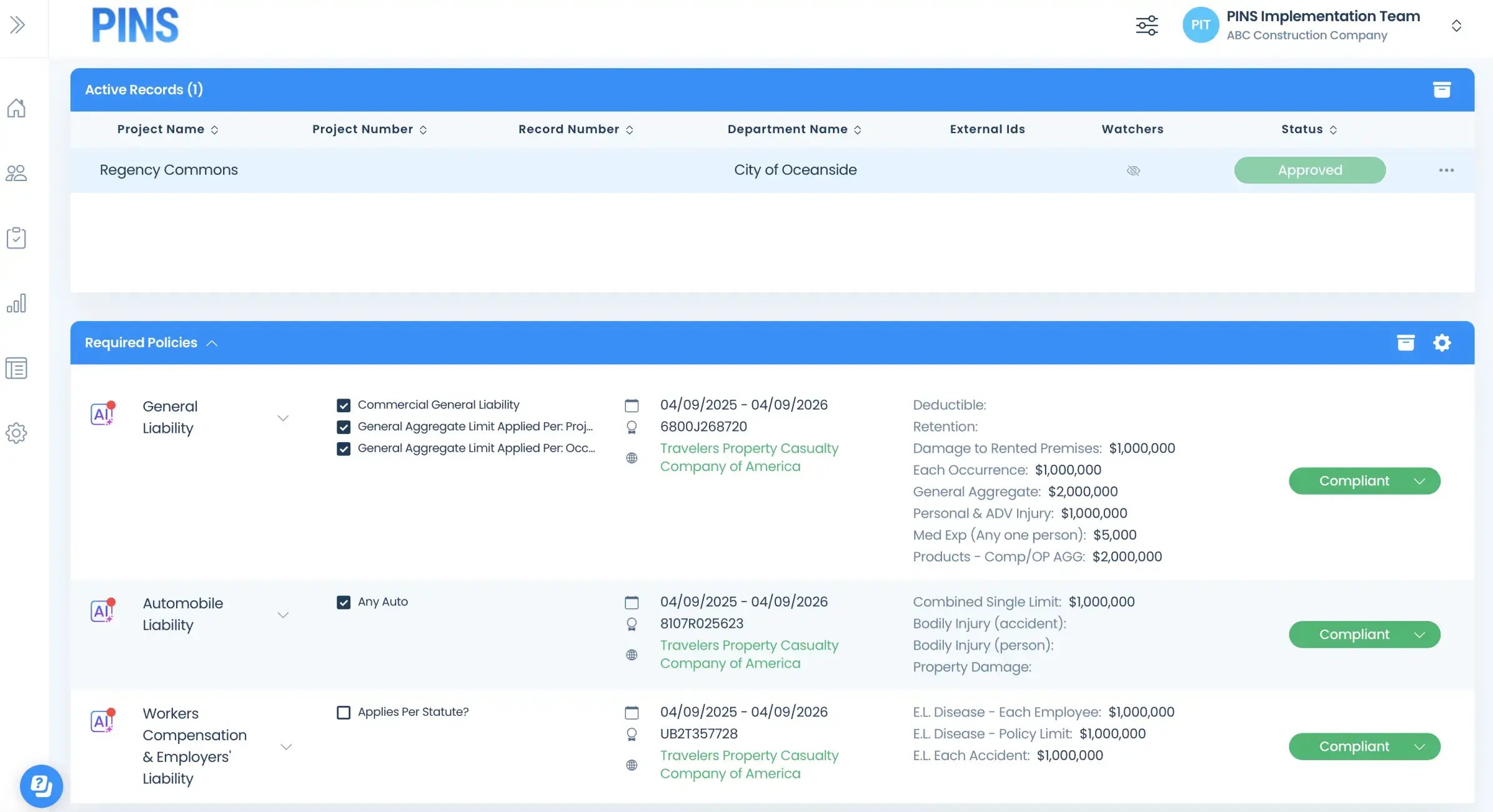
PINS is built for self service risk control, your team keeps decisions in house while automation removes the chasing
Decision ownership plus waiver and exception history stays tied to each third party.
Automated outreach reduces late expirations that show up at site access or payment release.
Real time compliance view by project and location, so gaps do not hide in inbox threads.
Common questions
The decision comes down to how much control you need over compliance decisions and how much visibility matters day to day. Teams that need to manage exceptions, waivers, and nuanced requirements quickly are usually better served by in-house software with automation. They keep the context and the decision history. Teams with very low COI volume and simple requirements may find an outsourced service sufficient, but most teams managing more than 100 COIs per year find the handoffs and lag create more work than they save. For a full breakdown of the platforms worth evaluating, see Best COI Tracking Software in 2026.
Not usually at scale. Outsourced services typically price per COI reviewed, which compounds quickly as vendor volume grows. In-house software generally uses flat or volume-tiered pricing that becomes more cost-efficient as the number of COIs increases. Beyond direct cost, outsourced models can create hidden costs in delayed approvals, slower exception resolution, and the internal time still required to handle escalations and edge cases.
The biggest losses are visibility and speed on exceptions. When a vendor's COI has an issue that requires context -- a project-specific endorsement requirement, a waiver that was previously approved, a relationship your team manages directly -- an outsourced reviewer does not have that context and cannot act on it without escalating back to you. Teams often find they are still involved in the process, just with less information and more lag than if they had managed it in-house.
Teams managing fewer than 50 COIs per year with simple requirements can often get by with a spreadsheet and manual follow-up. Once volume exceeds 100 COIs per year, or requirements include endorsement review, project-level tracking, or audit documentation, dedicated software pays for itself quickly in time saved and compliance gaps avoided. The tipping point is usually when one person is spending more than a few hours per week on COI-related follow-up.
Stop Reviewing.
Start Approving.