Last updated: September 18, 2026
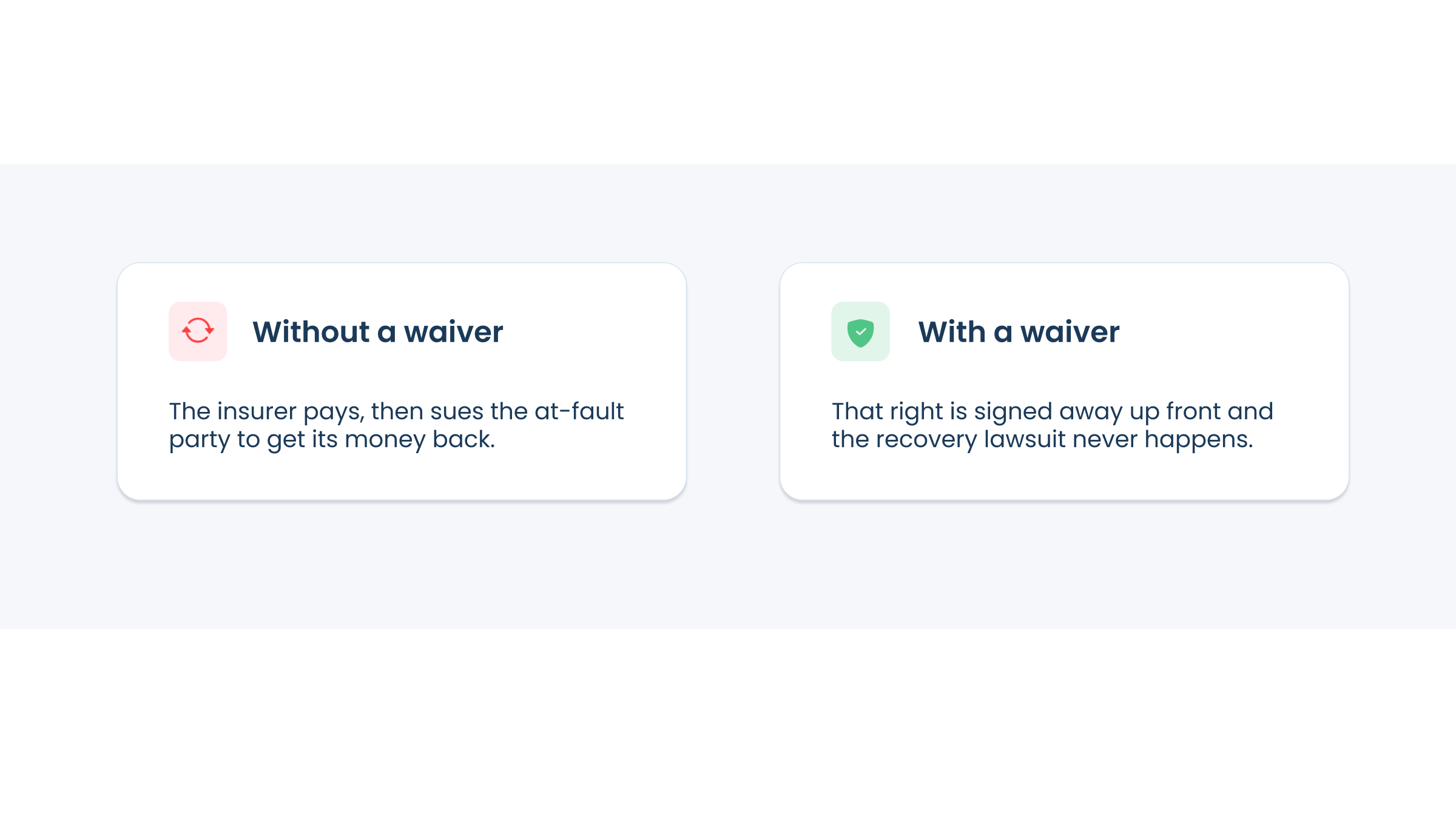
After a vendor's carrier pays a claim, it has the right to come after whoever caused the loss to recover what it paid. That process is called subrogation. A waiver of subrogation is the vendor's agreement to give that right up, in advance, so their carrier cannot pursue you.
This is the third piece of the standard risk transfer requirement. Additional insured endorsements give you standing on the vendor's policy. Primary and non-contributory language controls how that policy responds relative to yours. Waiver of subrogation closes the loop by making sure the vendor's carrier cannot turn around and come after you once the claim is resolved.
How subrogation works
Subrogation is a standard insurance principle. When a carrier pays a covered loss, it steps into the shoes of the insured and acquires the right to pursue any third party responsible for that loss.
A simple example: a vendor's employee damages equipment on your property. The vendor's carrier pays the claim. The carrier then determines that your team's negligence contributed to the incident. Without a waiver of subrogation, the carrier can file suit against you to recover what it paid.
You were an additional insured on the vendor's policy. The claim was paid. And now you are being sued by the same carrier that just covered the loss.
A waiver of subrogation prevents that from happening.
Waiver of subrogation is a standard requirement in construction contracts, particularly where general contractors are managing multiple subcontractors on a single project.
What the waiver actually does
When a vendor's policy includes a waiver of subrogation in your favor, the carrier agrees upfront that it will not pursue recovery against you after paying a claim, regardless of whether your negligence contributed to the loss.
This is not a waiver of coverage. The vendor's policy still pays claims. The carrier is simply giving up its right to pursue you afterward.
From a risk management standpoint, this matters because additional insured status alone does not protect you from subrogation. A carrier can name you as an additional insured for one purpose and still pursue you through subrogation for another. The waiver has to be separately obtained and separately verified.
If your contracts require waiver of subrogation, software that tracks endorsement status removes the manual review burden.
Where it lives in the policy
Waiver of subrogation is added to a policy by endorsement. On a general liability policy, the relevant ISO form is the CG 24 04 (Waiver of Transfer of Rights of Recovery Against Others). Workers compensation policies use a separate endorsement, commonly the WC 00 03 13.
Both are worth requiring. GL subrogation waivers cover property damage, bodily injury, and related claims. Workers compensation subrogation waivers cover situations where the vendor's carrier pays a workers comp claim and then seeks to recover from you as a contributing party.
Like additional insured endorsements and primary and non-contributory language, the waiver cannot be confirmed from the ACORD 25 alone. The certificate has a checkbox for waiver of subrogation. A checked box means it was requested. The endorsement on the policy is the only confirmation.
For general contractors managing endorsement requirements across a subcontractor roster, see how GC teams handle this in PINS.
What to look for in the endorsement language
For the GL waiver (CG 24 04 or equivalent): confirm the Schedule names your organization or states "Where Required by Written Contract," and the waiver covers both ongoing operations and completed work. The waiver applies only to the person or organization named in the Schedule. A blank or missing Schedule means the waiver may not apply to your relationship with the vendor.
For the workers compensation waiver (WC 00 03 13 or equivalent): confirm the Schedule includes your organization or uses blanket language such as "Any person or organization where waiver of our right to recover is permitted by law and is required by written contract." Also confirm the contract requiring the waiver was executed before the date of loss, most WC waiver forms include this condition explicitly.
For both waivers: the written contract is what activates the endorsement. A verbal agreement or unsigned contract will not trigger the waiver. Your contract must require waiver of subrogation in writing before any loss occurs.
What to look for when reviewing
The waiver appears on the endorsement, not just the certificate. Request the endorsement page. It should identify you or your organization as the party in whose favor subrogation rights are waived, or apply blanket coverage to any party required by contract.
The waiver covers both GL and workers compensation. A GL waiver without a workers comp waiver leaves a gap. Workers comp claims are common on construction and facilities projects, and subrogation recovery actions against owners and hiring parties are not unusual. Require both.
The waiver applies to ongoing and completed operations. Some waivers are scoped to active project periods. If a workers comp claim surfaces after project close and the waiver expired with the project, you may have exposure. Confirm the scope matches the contract requirement.
Blanket waivers are acceptable but require review. Many carriers issue blanket waiver of subrogation endorsements that apply to any party required by contract. These work, but confirm the blanket language is broad enough to cover your organization and the contract relationship. Carrier-specific wording varies.
A common misconception
Some teams assume that an indemnification clause in the contract handles subrogation risk. It does not.
An indemnification clause is a contractual promise from the vendor to defend and hold you harmless. Subrogation is an action by the carrier, not the vendor. The carrier is not bound by the vendor's indemnification agreement. It can pursue subrogation independently, regardless of what the contract says between you and the vendor.
The waiver of subrogation endorsement is what binds the carrier. The indemnification clause does not substitute for it.
How this connects to the endorsement cluster
The three standard risk transfer requirements work together:
- Additional insured endorsements give you direct standing on the vendor's policy for covered claims
- Primary and non-contributory language ensures the vendor's policy responds first without pulling yours in
- Waiver of subrogation ensures the vendor's carrier cannot recover from you after paying a claim
A contract that requires all three, and a compliance program that verifies all three, creates a defensible risk transfer posture. A contract that requires one or two leaves a gap that may not surface until a claim is already in progress.
Most COI programs verify the certificate. Few verify the endorsements. The endorsements are where the actual protection lives.
Where compliance programs fall short
Waiver of subrogation is the most commonly skipped verification in COI programs. Teams collect the certificate, see the checkbox, and mark it compliant. The endorsement is never reviewed. The workers comp waiver is rarely requested at all.
The gap is invisible during normal operations. It shows up when a claim hits and the vendor's carrier files a subrogation action against you on a project you thought was closed.
Contracts should require the waiver. The compliance program should verify it exists on both the GL and workers comp policies, and should confirm the wording is broad enough to cover the relationship.
How PINS handles waiver verification
Waiver of subrogation needs to appear on both the GL and workers comp policies. The certificate checkbox does not confirm either one. PINS reviews waiver endorsement language on both, flags missing or narrowly scoped waivers, and provides its reasoning so your team can see exactly what was found and what is not there.
Your team reviews the flag and approves, rejects, or waives. Nothing is auto-approved.
If your contracts require waiver of subrogation, COI tracking software that verifies endorsement language removes the manual review burden.
See how the PINS AI Assistant handles endorsement review. For how workers comp COI documentation connects to your annual audit exposure, see How COI Tracking Protects You in a Workers Comp Audit.
Frequently asked questions
What is the difference between waiver of subrogation and additional insured status?
Additional insured status gives you direct standing to make a claim under the vendor's policy. Waiver of subrogation prevents the vendor's carrier from coming after you to recover what it paid on a claim. They serve different purposes and both are typically required in vendor and subcontractor contracts. Having one without the other leaves a gap.
Does a waiver of subrogation apply to workers compensation policies?
Yes, but it requires a separate endorsement. The GL waiver covers general liability claims. Workers compensation subrogation waivers use a different form -- commonly the WC 00 03 13 -- and need to be collected and verified separately. Workers comp subrogation actions against hiring parties are common on construction projects, making this endorsement as important as the GL waiver.
Can a vendor's carrier pursue subrogation even if the contract includes an indemnification clause?
Yes. An indemnification clause is a promise from the vendor to defend and hold you harmless. Subrogation is an action by the carrier, not the vendor. The carrier is not bound by the vendor's contract with you and can pursue recovery independently. The waiver of subrogation endorsement is what binds the carrier. An indemnification clause does not substitute for it.
What is the WC 00 03 13 endorsement?
WC 00 03 13 is the standard ISO endorsement form used to add a waiver of subrogation to a workers compensation policy. It prevents the workers comp carrier from pursuing recovery against you after paying a claim. Some carriers use proprietary forms with equivalent language. Require it explicitly in contracts alongside the GL waiver and verify it exists on the workers comp policy.
How long does a waiver of subrogation need to stay in effect?
The waiver should remain active for as long as there is potential liability exposure from the vendor's work. On construction projects, that typically aligns with the completed operations tail period defined in the contract. Confirm the scope of the waiver matches the contract requirement -- some waivers are scoped to active project periods only and may not cover post-completion claims.