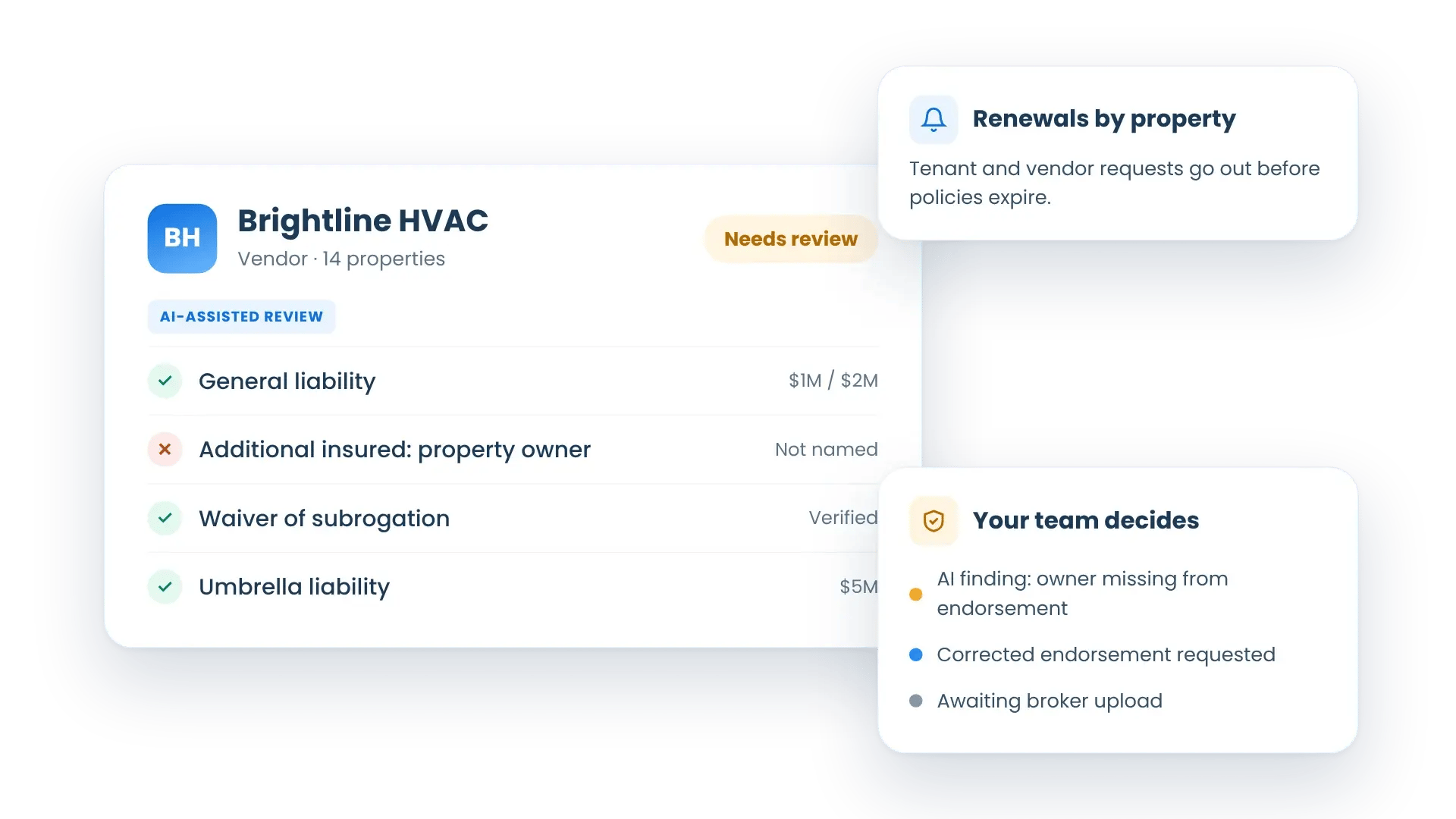
Endorsements name the wrong entity
Each property is often held by its own LLC. A certificate can list the management company and still miss the owner entity the lease or contract requires.
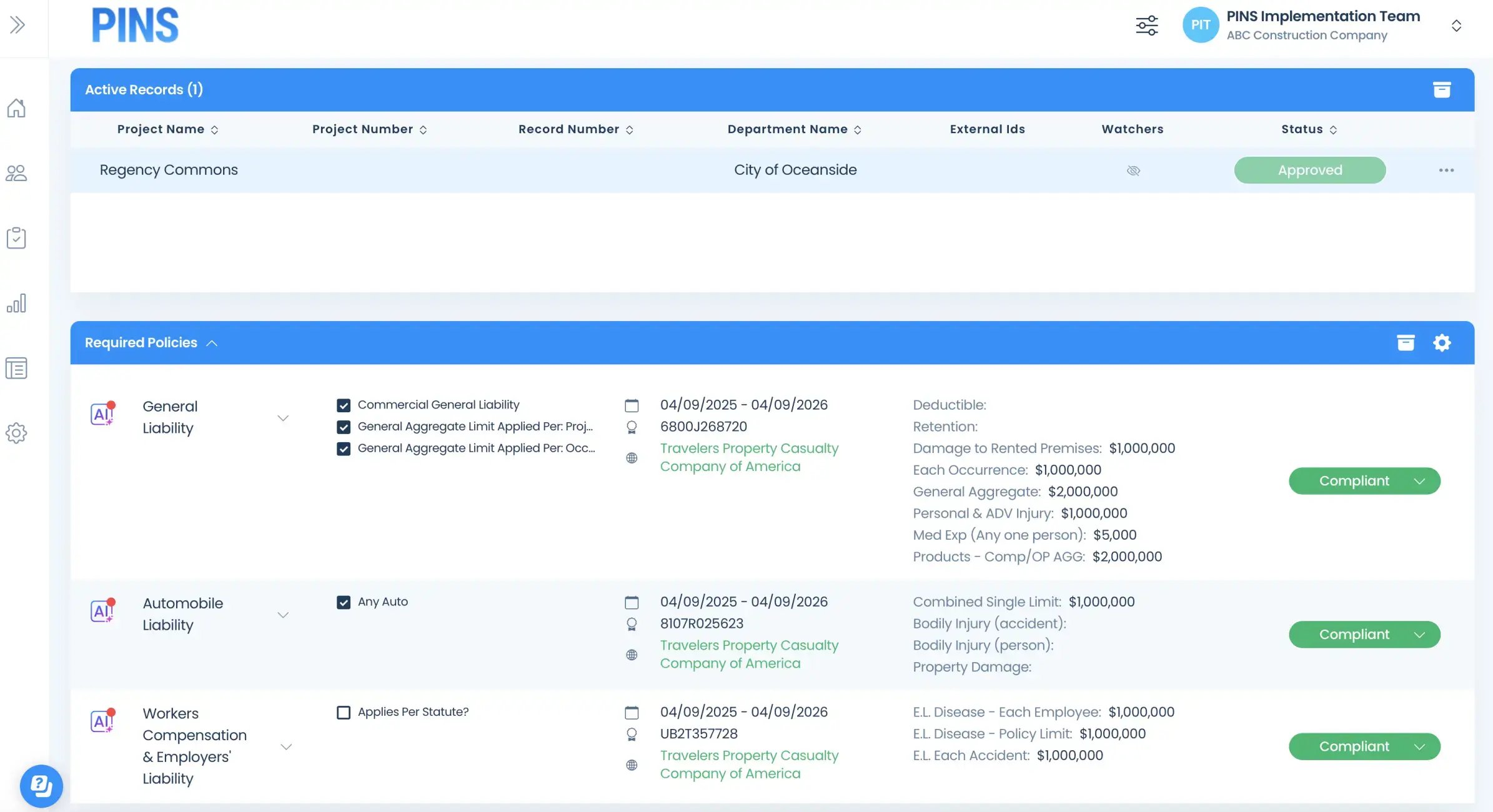
Property management COI tracking software collects, reviews, and renews certificates of insurance from tenants and vendors across every property you manage. AI-assisted review checks that each one names the right owner entity and management company. Your team makes the final compliance decision.
Common breakdowns
Every property has its own owner entity, its own tenants, and its own vendors. When each site tracks insurance its own way, renewals slip and endorsements name the wrong party.
Each property is often held by its own LLC. A certificate can list the management company and still miss the owner entity the lease or contract requires.
Insurance is collected at lease signing or contract award, then each site is left to chase renewals on its own.
Owners and asset managers expect to see insurance status for their buildings, but the data lives in spreadsheets and inboxes across sites.
| Tenant or vendor type | Commonly required coverage |
|---|---|
| Retail and restaurant tenants | General liability, property or contents coverage, liquor liability where alcohol is served, workers compensation if the tenant has employees |
| Office and industrial tenants | General liability, property or contents coverage, workers compensation, business interruption where the lease requires it |
| Tenant improvement and construction contractors | General liability with completed operations, auto liability, workers compensation, umbrella, and builder’s risk as the project requires |
| HVAC, electrical, plumbing, and elevator contractors | General liability with completed operations, auto liability, workers compensation, umbrella |
| Janitorial, landscaping, and maintenance vendors | General liability, auto liability, workers compensation and employer’s liability |
| Snow and ice removal | General liability without snow and ice exclusions or sublimits, auto liability, workers compensation |
| Security and parking operators | General liability, auto liability, workers compensation, garage keepers liability for parking operators |
Most leases and service contracts require more than a certificate.
How it works
Requirements, collection, review, and renewals in one place, organized by property and owner.
Pull requirements from leases and contracts
Upload a lease or service contract and PINS extracts the requirements, including the exact entities to be named as additional insured. Or use templates by tenant or vendor type, built with your implementation team.
Tenants and vendors upload
Requests go out from your own email domain. Tenants, vendors, and their brokers upload certificates and endorsements through a secure link with no login required.
AI checks every endorsement
AI-assisted review checks additional insured, waiver, and primary wording against the lease or contract and identifies issues, including a missing owner entity. Your team makes the final compliance decision.
Renewals and reporting by property
Renewal requests go out automatically before each policy expires. Filter status by property, owner, or vendor, and export to Excel when owners ask.
Spreadsheets and email managed at each property.
Portfolios with a handful of properties
Your team keeps control. Automation handles collection, review support, and renewals
Property teams managing tenants and vendors across a portfolio
A third party collects and reviews documents for you
Teams that want to hand off the work entirely
FAQ
Answers for property teams managing tenant and vendor insurance across a portfolio.
COI tracking software for property managers collects, reviews, and tracks certificates of insurance from tenants, vendors, and contractors across a portfolio. PINS sets requirements by lease or contract, checks endorsements with AI-assisted review, and sends renewal requests automatically. Beven & Brock, Aztec Shops at San Diego State University, and Associated Students at CSU Fullerton use PINS to manage tenant and vendor insurance.
Most commercial leases require general liability, property or contents coverage for the tenant’s improvements and belongings, and workers compensation if the tenant has employees. Restaurants and bars usually add liquor liability. Leases also commonly require the owner and management company to be named as additional insured, along with a waiver of subrogation and primary and non-contributory wording.
Usually the property owner entity, which is often a separate LLC for each property, and the management company. Lenders are sometimes added as well. The names should match the lease or contract exactly. PINS pulls the entities to be named from your documents, and AI-assisted review checks each endorsement against them, so a certificate that lists only the manager is caught before it is approved. For more, see additional insured endorsements explained.
Yes. Every tenant and vendor record is tied to its property, and reports can be filtered by property, owner, or vendor and exported to Excel. That makes it easier to answer owner and asset manager questions without rebuilding a spreadsheet.
PINS tracks each policy’s expiration separately and sends renewal requests automatically, starting 30 days before expiration and continuing until updated insurance is received. Renewed certificates go through the same review, so coverage stays current without each site chasing it. For more, see how to manage COI renewals.
No. Tenants, vendors, and their brokers upload certificates and endorsements through a secure link with no login required. Requests come from your own email domain, so they know who is asking.
PINS does not have native integrations with Yardi, AppFolio, or other property management platforms. Teams that need to connect systems can use the PINS API, which is available as an add-on.
PINS lets you waive requirements as needed to keep projects on track. Every waiver and exception stays tied to the right tenant, vendor, and property, with a record of who approved it and when. Your team makes the final compliance decision.
Stop Chasing COIs.
Start Approving.