Last updated: September 19, 2026
The best COI tracking software for most teams in 2026 depends on one decision: do you want to keep compliance in-house with automation, or hand it off to a managed service. PINS is the strongest fit for teams that want in-house control. illumend and Jones are built for teams that want to outsource review. The right choice comes down to operating model, not features. This post covers what each platform does well, who each one fits, and what to look for before you start demos.
What to look for before you evaluate
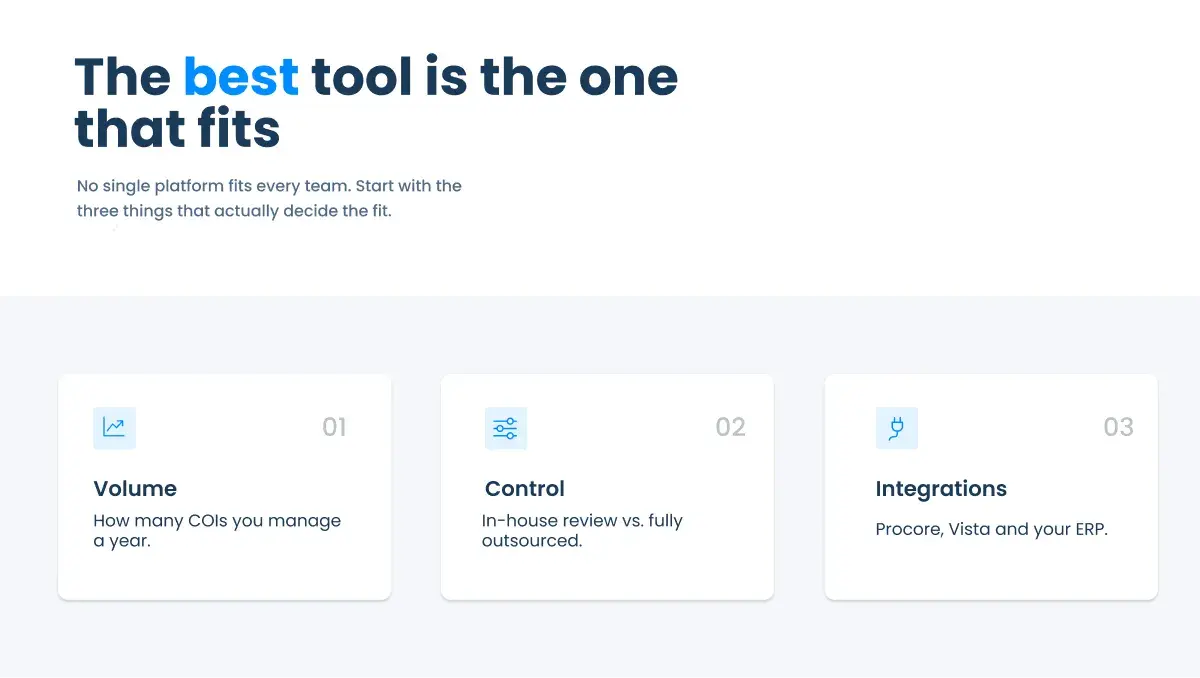
Before comparing platforms, get clear on three things.
How much volume do you manage? Teams under 50 vendors per year can often manage with a lightweight tool. Teams over 100 COIs per year with complex endorsement requirements generally need dedicated software.
How much control do you want to keep in-house? Some platforms are fully outsourced: their team reviews documents and makes compliance decisions for you. Others are self-service: your team reviews and approves, with software automating collection and tracking. These are fundamentally different operating models and the distinction matters more than any individual feature.
What integrations matter? If your team runs on Procore, Vista, or another construction ERP, integration depth determines whether compliance status actually surfaces where project managers and AP teams work.
For a structured list of questions to bring into demos, download the COI Tracking Software Evaluation Checklist.
The platforms worth evaluating in 2026
PINS Advantage
Best for: Teams that want in-house control with automation across construction, public agencies, property management, and insurance agencies.
PINS is self-service COI tracking software. You set requirements, vendors and brokers submit through a no-login upload link, the AI Assistant reviews documents against your requirements and flags gaps with evidence and reasoning, and your team approves, rejects, or waives. Compliance decisions stay in-house. The platform tracks expirations, automates renewal outreach, and keeps a full history of approvals, waivers, and exceptions for audit purposes.
Strong fit for general contractors and heavy civil teams because of native Procore and Vista integrations. Compliance status surfaces directly in the systems project managers and AP teams already use. Also strong for public agencies, property management teams, and insurance agencies managing COIs for clients.
Support is US-based and staffed by full-time product experts, not a general helpdesk or outsourced support team. The same person who runs your implementation stays with your account after go-live. When something comes up, you reach someone who knows your setup.
PINS is not the right fit for teams that want full managed service with no internal involvement in compliance decisions.
illumend (formerly myCOI)
Best for: Teams that want fully automated COI management and are comfortable delegating compliance decisions to AI without human review in the loop.
illumend is the AI-powered rebrand of myCOI, rebuilt around an AI engine called Lumie that handles certificate review, compliance decisions, and vendor follow-up automatically. The pitch is zero internal involvement. Insurance compliance involves endorsement language, contract-specific exceptions, and coverage judgment calls that automated systems routinely misread or miss entirely. When the AI gets it wrong, the gap may not surface until a claim.
For a deep dive of why that distinction matters, see AI in COI Tracking: How Much Should the AI Decide.
The platform is a full rebuild with limited time in market at scale. Teams buying illumend today are trusting a recently released system with their compliance program, without the track record that comes from years of real-world use across varied requirements and edge cases.
Pricing is not published and carries a reputation for being significantly higher than self-service alternatives.
Not the best fit for teams that want human review retained on compliance decisions, or organizations where audit defensibility requires documented human judgment on approvals, waivers, and exceptions.
For a full side-by-side breakdown, see how PINS compares to illumend.
Jones
Best for: Construction and commercial real estate teams that want fast managed review with strong Procore integration and are comfortable with compliance decisions happening outside their team.
Jones combines software with managed review services. COI review turnaround is typically under 24 hours and Procore and property management system integrations are strong.
Jones markets a network of over 30,000 pre-collected vendor profiles as a key differentiator. In practice, most teams already have established vendor and subcontractor relationships. Onboarding those vendors through a new platform takes the same effort regardless of whether they are in a pre-existing network.
The core tradeoff is operating model. When exceptions, waivers, or nuanced requirements come up, your team still gets pulled back in without the context that comes from managing the relationship directly. Outsourced reviewers cannot answer for your business, your project, or your history with a specific vendor.
Not the best fit for teams that want to keep compliance decisions in-house, or public agencies with strict vendor management requirements.
For a full side-by-side breakdown, see how PINS compares to Jones.
BCS (Business Credentialing Services)
Best for: Teams that want a mix of AI-assisted review and human analyst support with transparent per-vendor pricing.
BCS has been in the COI tracking space since 2008, though the current AI platform is a recent release with limited time in market at scale. Teams evaluating BCS today are buying into a newer product built on a longer compliance history.
The platform combines AI document review with human analyst oversight and offers a full-service managed option for teams that want vendor outreach handled externally. Pricing starting at $0.95 per vendor per month is one of the more transparent models in the market. A freemium tier supports teams under 25 vendors.
BCS is a general compliance platform serving multiple industries. Teams with complex construction endorsement requirements, project-level tracking needs, or Procore and Vista integration requirements may find the fit less precise than purpose-built alternatives.
For a full side-by-side breakdown, see how PINS compares to BCS.
TrustLayer
Best for: Tech-forward teams that want API-first verification across multiple industries and have technical resources to manage setup and ongoing workflow gaps.
TrustLayer automates insurance verification across construction, commercial real estate, lending, healthcare, and franchises. API integration capabilities are strong for teams that want compliance data embedded in existing systems.
TrustLayer markets real-time insurance verification as a core differentiator, with direct connections to carrier systems rather than document-based review. In practice, carrier integrations cover a limited subset of the market. Teams whose vendors are not with integrated carriers still rely on standard document collection and review, which is the same process every other platform uses. The real-time verification advantage only applies when the vendor's carrier is one of the few TrustLayer has an active integration with.
Independent reviews note that TrustLayer oversells AI capabilities in practice. Documents still require manual review more often than the demo suggests, reporting requires workarounds, and non-compliance workflows can be harder to manage at scale. Teams that go live often find themselves building manual processes to fill gaps the platform does not cover.
Not the best fit for teams that want a ready-to-run workflow out of the box, teams without technical resources to manage integration setup, or teams whose vendor base spans carriers outside TrustLayer's integration network.
For a full side-by-side breakdown, see how PINS compares to TrustLayer.
EvidentID
Best for: Enterprise teams that need third-party risk management across multiple verification types, where COI tracking is one requirement among many.
Evident is a broad third-party risk and compliance platform covering COI tracking alongside identity verification, license checks, due diligence, and vendor onboarding. The platform serves SMBs through Fortune 500 companies and public entities, with a network of over four million members. For organizations that need a single platform to manage multiple types of vendor verification, that breadth is the draw.
For teams whose primary need is COI tracking specifically, the fit is less precise. The platform's COI workflow is one module within a larger system built for broader verification use cases. Teams with complex construction endorsement requirements, project-level tracking, or Procore and Vista integration needs are likely to find the depth lacking compared to purpose-built COI platforms.
Support responsiveness has drawn some criticism in public reviews, with users noting delays in hearing back from the help desk on issues. Worth factoring in if your team needs fast resolution on compliance questions.
Not the best fit for teams whose primary use case is COI and endorsement tracking, or organizations that need construction-specific workflows and integrations.
For a full side-by-side breakdown, see how PINS compares to Evident.
How the operating models differ
Features matter less than operating model. That is the most important distinction in this market.
Self-service platforms give your team the tools to manage compliance in-house. Automation handles collection, tracking, and follow-up. Your team makes final decisions on approvals, waivers, and exceptions. You keep the context. You keep the history. You keep the control.
Managed service platforms take document review and follow-up off your plate. The tradeoff is less visibility into day-to-day decisions, slower turnaround on edge cases that need your input, and a third party sitting between you and your vendors.
Neither model is wrong. Managed service makes sense for teams that genuinely do not have bandwidth for in-house review. Self-service with automation makes sense for teams that want control, visibility, and a compliance program that does not depend on a third party's queue.
Questions worth asking any vendor
Does the platform review documents or just store them? Document storage is table stakes. Review means checking actual coverage against your requirements: limits, endorsements, additional insured status, effective dates.
How does vendor submission work? Platforms that require vendors to create accounts see lower submission rates. No-login submission is a meaningful operational difference, not a minor convenience.
How deep do integrations go? A nightly CSV export is not the same as a real-time sync. Ask specifically how compliance status surfaces in Procore, Vista, or your ERP, and how current that data is.
Who makes the final compliance decision? On some platforms the software or a third-party team approves documents automatically. On others your team retains approval. Know which model you are buying before you sign.
What happens at renewal? Ask how many follow-up attempts are made, through what channels, and what happens when a vendor does not respond. Automated renewal outreach and expiration tracking vary significantly between platforms.
For a full set of evaluation questions organized by category, see How to Choose COI Tracking Software.
How PINS fits into this
PINS is built for teams that want to keep compliance in-house, automate the repetitive work, and have confidence the program is audit-ready when leadership or an owner asks for documentation.
Strong fit for general contractors, public agencies, property managers, and insurance agencies. Procore and Vista integrations keep compliance status where your team already works. AI-assisted endorsement review with human approval retained means faster review without giving up judgment on the decisions that matter.
For how AI endorsement review actually works in practice, see How AI COI Review Works in 2026.
Frequently asked questions
What is the best COI tracking software in 2026?
The best COI tracking software depends on your operating model. Teams that want to keep compliance decisions in-house with automation generally fit self-service platforms like PINS. Teams that want full managed service where a third party handles review fit platforms like illumend or Jones. No single platform is the best fit for every team, the right choice comes down to volume, industry, integration needs, and how much control you want to retain.
What is the difference between self-service and managed COI tracking?
Self-service COI tracking means your team manages the compliance process using software that automates collection, review, and renewals. Your team makes every final decision. Managed COI tracking means a third-party service handles document collection and review on your behalf. Self-service gives you more control and visibility. Managed service reduces internal involvement but adds a third party between your team and your vendors.
How much does COI tracking software cost?
Pricing varies significantly by platform and operating model. Self-service platforms typically use flat or volume-tiered pricing. Managed service platforms often price per COI reviewed, which compounds as vendor volume grows. BCS publishes pricing starting at $0.95 per vendor per month. Most other platforms require a demo before pricing is shared. For PINS specifically, pricing is available at pinsadvantage.com/pricing.
What should I look for when evaluating COI tracking software?
Start with operating model, self-service versus managed, since that determines how much your team is involved day to day. Then evaluate document review depth (does it check endorsements or just store certificates), vendor submission experience (no-login upload versus account creation required), integration depth with Procore, Vista, or your ERP, and audit history for approvals, waivers, and exceptions. For a structured evaluation framework, see How to Choose COI Tracking Software.