Last updated: August 21, 2026
Every COI software vendor claims to use AI. That claim means nothing without one follow-up question: which actions is the AI allowed to take on its own?
Some platforms, like illumend, let the AI approve submissions, reject vendors, and close compliance gaps without anyone on your team seeing it happen. Others call out issues and wait for your team to act. Those are not variations of the same thing. They are fundamentally different compliance programs.
Before you evaluate any COI tracking platform, understand which one you are buying.
When the AI decides, your team finds out later
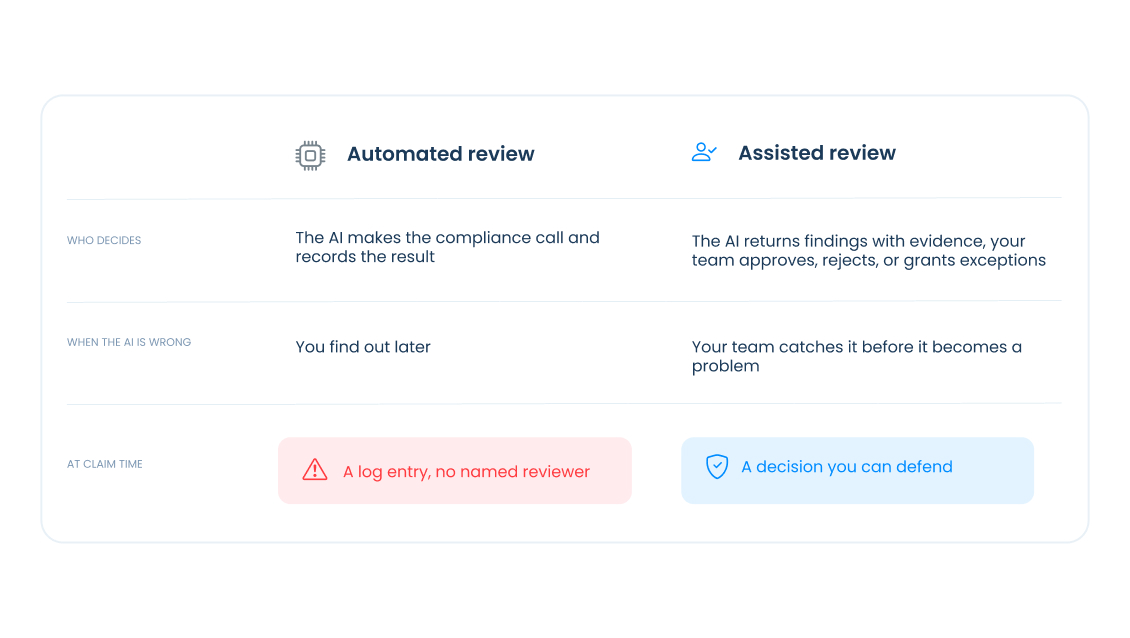
Fully automated review means the AI makes the compliance call. A submission comes in, the AI checks it, and the result is recorded without human review.
This sounds efficient until an endorsement with the wrong language gets approved because the AI matched the form number but did not read what the endorsement actually said. Or a mid-term policy cancellation gets missed because no human was checking. Or a blanket endorsement that does not meet contract specs passes because the AI recognized the form type rather than the language inside it.
At claim time, you cannot defend a decision your team never made. There is no documented judgment call, no named reviewer, no audit trail that shows a person assessed the risk and approved the submission. There is only a log entry that says the AI passed it.
That is not a compliance program. That is a liability gap with a software interface on top of it.
The question every vendor avoids answering
Ask any COI software vendor directly: which actions can the AI take without a human reviewing it first?
Most will pivot to features. They will show you the AI interface, describe how many data points the system checks, and explain how fast review happens. Push past that. Ask for a direct answer.
If the AI can approve a submission your team never sees, that is automated review. If the AI flags findings and your team makes every approval, that is assisted review. The difference determines your exposure when something goes wrong and an auditor, an owner, or a plaintiff's attorney asks who made the compliance call.
One more question worth asking: what happens when the AI is wrong? On a fully automated platform, the answer is that you find out later. On an assisted platform, the answer is that your team catches it before it becomes a problem.
Why your team should set that boundary, not the vendor
The right level of AI autonomy is not fixed. It depends on your vendor volume, your risk tolerance, your team's capacity, and the complexity of your requirements.
A general contractor managing 500 subcontractors across 20 active projects has different needs than a property manager with 30 tenants. A team doing high-risk public infrastructure work needs more human oversight than a team tracking basic vendor insurance for a low-risk property. A compliance program that is maturing may want more automation over time as it builds confidence in its requirements and vendor base.
A platform that locks every customer into the same AI autonomy level is not building software for your program. It is building one program and selling it to everyone.
Your team should control which actions the AI can take without review, what requires human sign-off, and where the AI stops and your team starts. That boundary should be yours to set and change as your program evolves. Not something a vendor decided for you when they built the product.
What configurable AI autonomy looks like in practice
Rather than a fixed model, your team should be able to choose how much the AI does autonomously across your entire program, or within specific requirement types.
Full human review. The AI reads every submission, returns findings with evidence, and waits. Your team approves, rejects, or grants exceptions on everything. Nothing moves without a human decision. This is the right default for programs that are new, high-risk, or where audit defensibility is a priority.
Auto-approval when all requirements are met. The AI reviews the submission, confirms every requirement is satisfied, and approves automatically. Your team only touches the exceptions, deficiencies, and edge cases that need human judgment. This works well for established vendor relationships with consistent compliance history.
Auto-reply for deficiencies. When a submission is missing something specific, the AI notifies the vendor automatically with the exact deficiency. Your team handles approvals and waivers. Routine correction requests do not require a human to write the same email fifty times a month.
Any combination. Some requirement types or vendor categories warrant full human review. Others are low-risk enough to auto-approve. A mature compliance program reflects those distinctions rather than applying one approach to every submission regardless of risk.
The point is not that more automation is better or that more human review is better. The point is that your team should make that call, not the platform.
How PINS approaches AI autonomy
PINS is built so your team controls what the AI Assistant is able to do on your behalf. It reviews every submission against your requirements and returns findings with evidence. Your team makes every final call.
When evaluating any platform on AI autonomy, question 5 of the COI Tracking Software Evaluation Checklist asks exactly the right question: does the AI decide automatically, or identify issues for your review? Bring that question into every demo.
Frequently asked questions
How much should AI decide in COI tracking software?
That depends on your program, your risk tolerance, and your team's capacity, and it should be a decision your team makes, not the vendor. At minimum, the AI should never take final compliance actions on endorsement language, exceptions, or waivers without human review. Those are judgment calls that require context the AI does not have. For routine submissions where all requirements are clearly met, some level of AI autonomy is reasonable as long as your team sets that threshold and retains the ability to change it.
What is the difference between AI-assisted and AI-automated COI review?
AI-assisted review means the AI reads submitted documents, checks them against your requirements, and returns findings for your team to act on. Your team makes every final decision. AI-automated review means the AI takes the compliance action itself, approving or rejecting submissions without human review. The distinction matters because only one of those models gives you a documented human decision when an auditor, an owner, or an attorney asks who approved a submission that later failed at claim time.
Can AI approve COIs without human review?
On fully automated platforms, yes. The AI reviews the submission and the action is recorded without a human seeing it. The more important question is whether you control which actions the AI takes on your behalf. On some platforms that boundary is set by the vendor and every customer gets the same model. On others your team sets it. Ask any vendor directly if you can control how much the AI acts on your behalf, or if it is an all or nothing setting.
What happens when automated COI review gets it wrong?
On a fully automated platform, you find out about issues when it matters most: at claim time, at audit, or when an owner asks for documentation. By then the compliance gap is already in the record and the submission your team never reviewed is the one you have to defend. On an assisted platform, your team catches the issue before the submission is approved because a human reviewed the AI findings before any action was taken.
How do I evaluate AI autonomy when comparing COI tracking platforms?
Ask two questions in every demo. First: which actions can the AI take without a human reviewing it first? Second: who controls that threshold, your team or the vendor? If the answer to the first question is everything that meets requirements and the answer to the second is that is set by the platform, you are looking at a fully automated model with no configurability. If the answer to both is your team decides, you have a platform built around your compliance program rather than a fixed product model.