Last updated: October 14, 2026
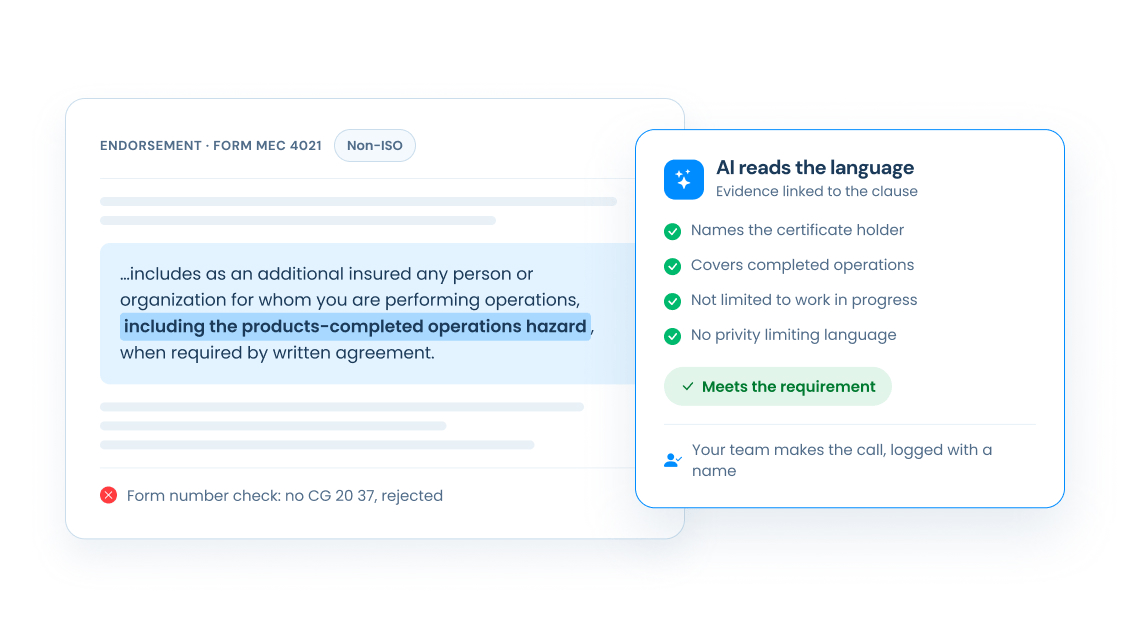
A subcontractor submits a certificate of insurance with a proprietary endorsement from their carrier. The endorsement conveys additional insured coverage for completed operations but does not use ISO form CG 20 37. A system checking for form numbers rejects it. A system reading the endorsement language knows it passes.
That distinction is what separates meaningful AI COI review from automated document filing. And it is where most platforms stop short.
The problem with checking form numbers
Form numbers are a reasonable starting point. CG 20 10 for ongoing operations, CG 20 37 for completed operations, CG 20 01 for primary and non-contributory: these are the standard ISO forms most contracts require. Checking for them is faster than reading every document manually.
But carriers frequently issue proprietary endorsements that convey equivalent coverage under different form numbers. Regional carriers, specialty markets, and surplus lines carriers commonly submit non-ISO forms. A system that rejects a submission because it does not contain CG 20 37 may be rejecting a document that fully satisfies the requirement. A system that accepts it because the form number is present may be approving a document where the language does not hold up.
The form number tells you what was requested. The language tells you what was actually provided. AI review that reads the language rather than matching form numbers closes the gap that form-number checking creates.
What AI COI review actually reads
A complete COI submission is not just the ACORD 25. It includes the certificate, the GL additional insured endorsements, the waiver of subrogation documents, per-project endorsements, and in some cases pollution liability policies and umbrella declarations. Each document carries different compliance information and each needs to be reviewed against your specific requirements.
Effective AI COI review reads the full submission. When a waiver of subrogation question applies to GL, auto, and workers comp coverage, the AI needs to find and read the waiver endorsements for all three, not just confirm a checkbox on the certificate. When a per-project endorsement is required, the AI reads the endorsement to confirm it covers the right project, names the right entities, and applies the right limits.
How AI reads endorsement language versus checking form numbers
The difference becomes clearest on the questions that matter most. Take completed operations additional insured coverage. A form-number check asks: does this submission include CG 20 37? An AI review that reads language asks something more precise:
Does this endorsement, regardless of form number, convey the following coverage: does it specifically name the certificate holder, cover completed operations or products-completed operations hazard, state that coverage applies to liability arising out of the named insured's work performed for the additional insured, not limit coverage to the time period during which operations are in progress, and trigger coverage based on completed work?
A proprietary endorsement that satisfies all five criteria passes. A standard CG 20 37 with language that was modified to limit coverage fails. Form-number checking would get both wrong.
The same reading approach applies to privity of contract language. Some endorsements include limiting language; phrases like "only where required by written contract" or "but only to the extent required by a written contract"; that restrict when coverage actually applies. A form-number check does not catch this. An AI reading the endorsement language can identify whether that limiting language is present and flag it as a potential compliance issue before your team approves the submission.
Preset questions versus custom questions
AI COI review is only as precise as the questions it is answering. There are two approaches.
Preset questions use standard compliance definitions for common requirements: additional insured, waiver of subrogation, primary and non-contributory, general aggregate per project. These cover the requirements most contracts share and give teams a reliable starting point without any configuration work.
Custom questions let your team write the exact compliance criteria that match your contract language. Instead of asking whether an endorsement conveys standard additional insured coverage, you can ask whether the endorsement conveys additional insured coverage with the specific language your contracts require. Teams with complex or project-specific requirements can encode those requirements directly into the review.
The setup happens once per requirement template. Then every submission from that point forward is automatically reviewed against the right template. The configuration work is front-loaded. The review runs automatically every time a document comes in.
This is where AI COI review earns its keep operationally. Reviewing fifteen endorsement criteria manually across three hundred subcontractors is not a reasonable ask of any compliance team. Running those same criteria automatically against every submission, with findings returned before your team opens the document, is.
Where AI COI review still needs humans
AI review handles the reading. It does not handle the judgment.
Contract-specific context. A question can be written precisely, but the answer sometimes depends on context the AI does not have. A vendor relationship that goes back ten years. A project where the owner accepted a modified endorsement in writing. A subcontractor whose carrier has a known pattern of submitting proprietary forms that your team has reviewed before. That context lives with your team, not in the document.
Exceptions and waivers. When a submission does not fully meet requirements, someone has to decide whether to reject it, request a correction, or grant an exception. That decision has legal and audit implications. It requires judgment about the vendor, the gap, the risk, and your organization's compliance posture. AI can identify the gap and explain what is missing. The decision belongs with your team.
Ambiguous language. Endorsements are sometimes written in ways that are genuinely ambiguous: language that could be read as conveying the required coverage or as falling short of it. AI can return a finding that reflects that ambiguity. A human reviewer has to make the call.
Audit accountability. When a claim occurs and documentation is reviewed, the compliance decisions on file need to be defensible. A log entry that says a submission was approved carries more weight when a named reviewer made that call than when an automated system did. Your team's judgment is what makes the compliance record meaningful.
The question of how much to trust AI
Trusting AI to read an endorsement and return findings is reasonable. Trusting it to make the final compliance call is a different question entirely.
For the full argument on why that boundary matters when evaluating platforms, see AI in COI Tracking: How Much Should the AI Decide.
How PINS AI review works
PINS reviews every submission against your configured requirements using preset questions, custom questions, or both. The PINS AI Assistant reads the full insurance submission, covering ACORD 25, GL endorsements, waiver of subrogation documents, per-project endorsements, and any other documents included in the submission, and returns findings with evidence linked to the specific language in each document.
When a submission includes a proprietary endorsement, PINS reads the language to determine whether it conveys the required coverage, not just whether it matches a form number. When a submission is missing an endorsement entirely, PINS identifies what is missing and links its reasoning to the requirement that was not satisfied.
Your team reviews the findings and makes every final compliance decision. Approvals, rejections, waivers, and exceptions are all logged with a timestamp and the name of the person who made the call.
Requirement templates are built once and applied automatically to every submission against that template. A compliance team managing multiple project types or vendor categories configures the templates once and the review runs automatically from that point forward.
For a full list of questions to ask any COI software vendor about AI review depth before you buy, download the COI Tracking Software Evaluation Checklist.
Frequently asked questions
How does AI COI review work?
AI COI review reads submitted insurance documents against a set of compliance questions and returns findings with evidence linked to the specific language in the document. Effective AI review reads the full submission; certificate, endorsements, waiver of subrogation documents, and any other documents included; rather than just the certificate. The AI checks whether each document conveys the required coverage, not just whether it contains a specific form number. Findings are returned to a human reviewer who makes the final compliance decision.
What is the difference between AI COI review and automated COI tracking?
AI COI review specifically refers to the analysis of submitted documents against compliance requirements, reading endorsement language, verifying coverage criteria, and identifying gaps. Automated COI tracking is a broader term that includes collection, expiration tracking, renewal reminders, and follow-up workflows. A platform can automate tracking without doing meaningful document review, and it can do AI-assisted review without automating the rest of the workflow. The most complete COI compliance programs do both.
Can AI read proprietary endorsement forms that are not standard ISO forms?
Yes, when the AI is reading endorsement language rather than checking form numbers. Carriers frequently submit proprietary or non-ISO endorsement forms that convey equivalent coverage under different form numbers. AI that reads the actual language of the endorsement and checks whether it conveys the required criteria, regardless of form number, can assess those documents accurately. AI that only checks for specific ISO form numbers will either reject valid proprietary endorsements or accept standard forms with modified language that does not actually meet requirements.
Where does AI COI review still require human judgment?
Human review remains essential for four categories: decisions that require contract-specific context the AI does not have, exceptions and waivers where the decision has legal and audit implications, genuinely ambiguous endorsement language where the AI identifies uncertainty, and any compliance decision that needs to be defensible in an audit or claim. AI handles the reading accurately and consistently. The judgment calls belong with your team.
How do you set up AI COI review questions?
Requirement templates are configured once per project type, vendor category, or compliance standard your program uses. Each template contains the questions the AI applies to every submission against that template: preset questions for standard requirements, custom questions for contract-specific criteria. Once a template is built, every new submission against it is reviewed automatically against the same set of questions without any per-submission setup. For teams managing multiple project types with different requirements, each type gets its own template.