Last updated: November 10, 2026
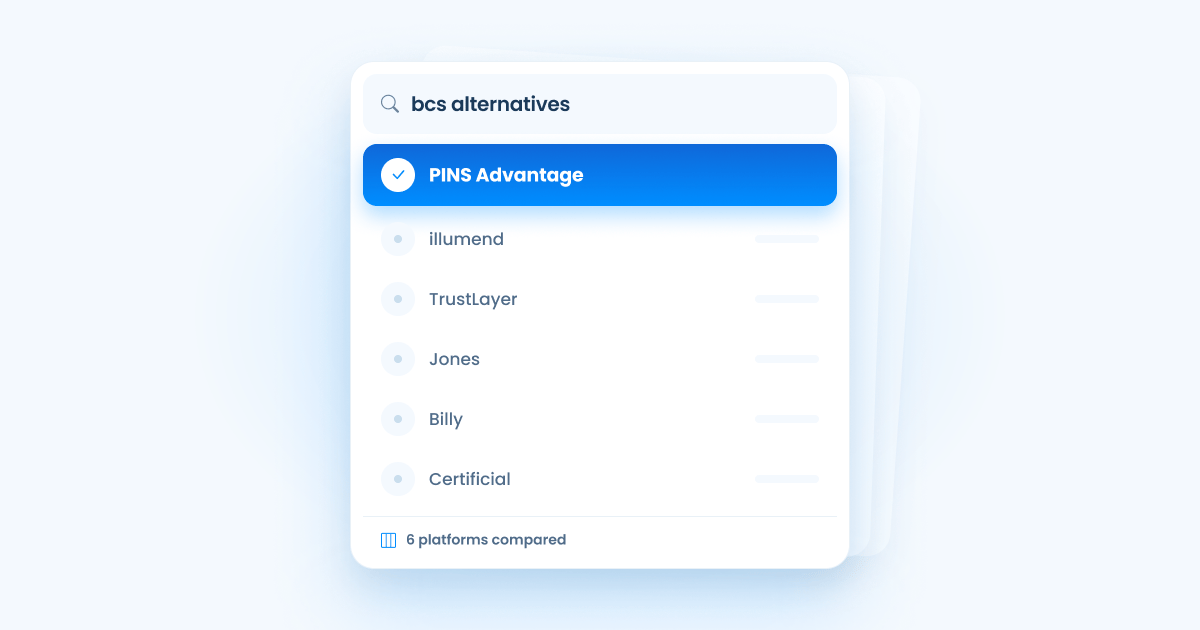
The best bcs alternatives in 2026 are PINS Advantage, TrustLayer, illumend (formerly myCOI), Jones, Billy, and Certificial. bcs (Business Credentialing Services) is one of the lowest-cost options on the market, so teams rarely leave it over price. They look elsewhere when they want deeper endorsement review on a self-service plan, construction payment workflows, or a different balance between software and service.
Start with one question: who do you want reviewing endorsements and making the compliance decision? Then compare what each plan actually includes.
bcs alternatives at a glance
| Platform | Model | Who decides | Best for |
|---|---|---|---|
| PINS Advantage | Software that reads endorsement language | Your team | In-house control with automation |
| TrustLayer | Software with a vendor network | Your team | Broker and vendor collaboration |
| illumend (myCOI) | AI-first platform (Lumie) | Lumie, with humans on edge cases | Teams that want AI to decide |
| Jones | Software or managed service | Your team or Jones specialists | Outsourcing insurance operations |
| Billy | Construction compliance software | Your team | GCs that also track W9s and licenses |
| Certificial | Connected COI network | Your team | Teams whose vendors' agencies use it |
Pricing and features are as listed on each vendor's website in November 2026.
How bcs works today
bcs is free for up to 25 vendors. Self-service runs about $0.95 per vendor per month, with unlimited users and integrations with Yardi, Procore, and MRI. Full-service starts at $17.80 per vendor per year with a $10,000 annual minimum, and adds compliance analysts, professional document review, corrective action on deficiencies, and phone outreach to vendors and agents.
bcs AI extracts COI data, identifies endorsement types, and walks reviewers through endorsements with questions and answers. bcs says nothing its AI concludes is applied automatically, and that a person signs off on suggestions.
Why teams look for a bcs alternative
- They want endorsement language reviewed without a service minimum. On bcs, professional document review and corrective action are part of full-service. Teams that want software to read the wording against their contracts, and keep review in-house, compare self-service options built around that.
- They need construction payment workflows. GCs often want compliance status tied to Procore Pay, or written back to Vista so AP can hold payment for a non-compliant sub.
- They want a tool built for their industry. bcs serves property management, franchises, education, and many other industries. Some construction and public agency teams want workflows built around subcontracts, owner requirements, and audit trails.
- They want contract-built requirements. They want the software to read the contract and build insurance requirements, instead of maintaining templates by hand.
Endorsement type vs. endorsement language
Identifying an endorsement type or form number tells you which endorsement is attached, such as CG 20 10 or CG 20 37. That is a useful first step, but it is not the same as reading the endorsement. Two endorsements with the same form number can provide very different coverage:
- Direct contract (privity) language that only covers parties the named insured has a written contract with, leaving out the owner or a GC above a sub-subcontractor.
- Ongoing operations only wording that leaves completed operations uncovered.
- Project or location limits that may not reach the job you care about.
- Carrier forms with their own wording and no standard form number to match.
The PINS AI Assistant reads the actual wording against your requirements, calls out whether equivalent coverage is provided, and identifies restrictions with its reasoning. Your team makes the final compliance decision.
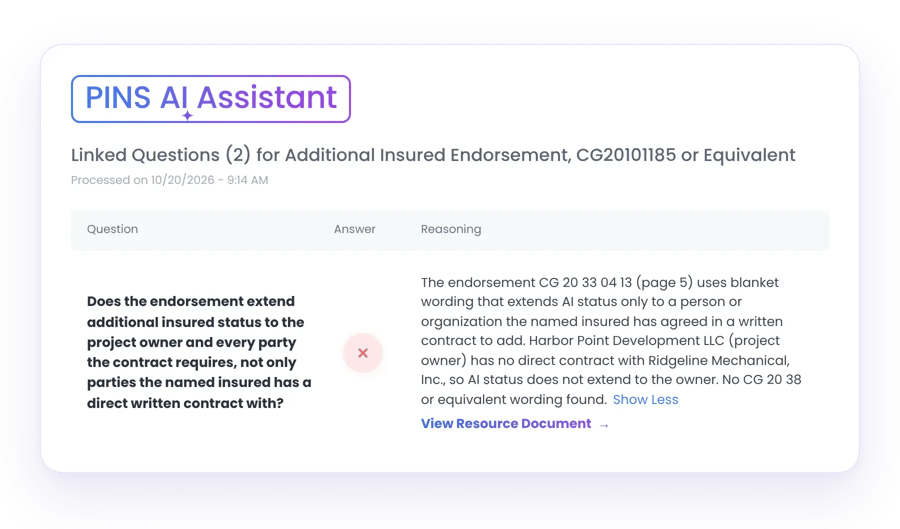
A PINS finding on a blanket additional insured endorsement with direct contract wording, with the reasoning and a link to the source page.
Whichever platforms you evaluate, run one of your own restrictive endorsements through review during the demo and see what it catches. For examples, see CG 20 10 and CG 20 37 Explained.
The best bcs alternatives
1. PINS Advantage
Best for: Teams that want software that reads endorsement language in-house, with their own team making the final compliance decision.
PINS is self-service COI tracking software. PINS reads your contract and builds the insurance requirements, or you assign requirement templates by vendor type. Vendors and brokers upload through a secure link with no login required. The PINS AI Assistant reads each COI and the actual endorsement language against your requirements, not just the form number, and identifies issues with the reasoning behind each one. Your team makes the final compliance decision.
PINS costs more than bcs self-service. The difference is what the software does on its own: it reads endorsement language against your contracts, builds requirements from the contract, connects to Procore Pay and Vista, and keeps review in-house without a $10,000 service minimum.
Renewal requests go out automatically before each policy expires, from your company's own email domain, and renewed COIs go straight into review. Every approval, waiver, and exception is logged under the person who made it. The Procore integration is included at no extra cost, with a side panel and Approved or Not Approved status written in real time to the commitment Compliance tab that Procore Pay checks. The Vista integration writes compliance back automatically so AP sees status before payment, and an API connects other systems. Plans include unlimited users, month-to-month options, and pricing that starts around $300 per month.
Customers report 85% less admin time on COI tracking and 90%+ ongoing vendor compliance. At Morley Builders, one person now does the COI work that used to take three. Read the Hummel Group case study. PINS is used by general contractors, public agencies like the City of Elk Grove, airports, property managers, and insurance agencies.
For a side-by-side, see PINS vs bcs.
2. TrustLayer
Best for: Teams that want a free starting tier with room for more vendors.
TrustLayer's Starter plan is free for up to 50 vendors, with Procore, CMiC, and Vista integrations on its Pro plan and an optional TrustLayer+ service add-on. See TrustLayer alternatives.
3. illumend (formerly myCOI)
Best for: Teams that want AI to make compliance decisions so their team can step back.
illumend describes its Lumie AI as reading every COI and endorsement and making the compliance decision, with humans handling edge cases. See illumend (myCOI) alternatives.
4. Jones
Best for: Teams that want a managed service like bcs full-service, with a construction and real estate focus.
Jones pairs AI with insurance specialists who verify review results, and its Jones Operator plan adds a dedicated specialist for vendor follow-up, waivers, and renewals. See Jones alternatives.
5. Billy
Best for: General contractors that also track W9s and business licenses.
Billy is construction-focused, syncs project and vendor data from Procore, and lets vendors and brokers upload without a login.
6. Certificial
Best for: Teams whose vendors' agencies issue Smart COIs through Certificial.
Certificial certificates update when the underlying policy changes. The value depends on how many of your vendors' agencies are on its network.
Questions to ask any bcs alternative
- On the plan we would buy, who reads the endorsement language: the software, a service team, or our staff?
- Do you read the endorsement wording, or identify the endorsement type? Can we run one of our restrictive endorsements through review in the demo?
- Where does compliance status show up for project managers and AP: Procore, Procore Pay, Vista?
- What is the total annual cost at our vendor count, including any minimums?
For more on the tradeoffs, see In-House vs. Outsourced COI Tracking and COI Tracking Software Pricing. For the full market, see Best COI Tracking Software in 2026.
See it on your own documents. Bring a sample contract and one of your restrictive endorsements to a demo. We will build your requirements from the contract and run the endorsement through review live on the call. Book a Demo
Switching from bcs to PINS
PINS imports your vendor list, usually at no charge, and existing records can be imported as an add-on. Connecting Procore takes about 15 minutes and Vista about 15 to 30 minutes. Most teams are live within a week, and a dedicated implementation rep stays with you after launch.
Frequently asked questions
What are the best alternatives to bcs for COI tracking?
The best bcs alternatives in 2026 are PINS Advantage, TrustLayer, illumend (formerly myCOI), Jones, Billy, and Certificial. PINS fits teams that want software that reads endorsement language in-house, with their own team making the final compliance decision. Jones fits teams that want a managed service like bcs full-service.
How much does bcs cost?
According to its pricing page, bcs is free for up to 25 vendors. Self-service runs about $0.95 per vendor per month. Full-service, where bcs analysts handle vendor outreach, document review, and renewals, starts at $17.80 per vendor per year with a $10,000 annual minimum. PINS pricing starts around $300 per month, with unlimited users and month-to-month options.
What is the difference between bcs self-service and full-service?
On bcs self-service, your team runs the compliance program and bcs software automates collection, deficiency notices, and renewal reminders. On full-service, a bcs team of compliance analysts reviews documents, corrects deficiencies, and calls vendors and their agents. Full-service carries a $10,000 annual minimum.
Does bcs review endorsements?
bcs AI identifies endorsement types and walks reviewers through endorsements with questions and answers. Professional document review is listed as part of bcs full-service. When comparing alternatives, ask whether the software reads the endorsement wording against your requirements on the plan you would buy. PINS reads the actual endorsement language against your requirements and identifies restrictions with its reasoning.
Why would a team pay more for PINS than bcs self-service?
For what the software does on its own. PINS reads endorsement language against your contract requirements, builds requirements from the contract, writes compliance status to Procore Pay and Vista, and keeps review in-house without a service minimum. Customers report 85% less admin time on COI tracking.
Which bcs alternative is best for general contractors?
For GCs that want to keep compliance in-house, PINS reads endorsement language against subcontract requirements, tracks sub-tier subcontractors, and connects to Procore, Procore Pay, and Vista. Billy fits GCs that also track W9s and business licenses. Jones fits GCs that want to outsource insurance operations.