Last updated: November 20, 2026
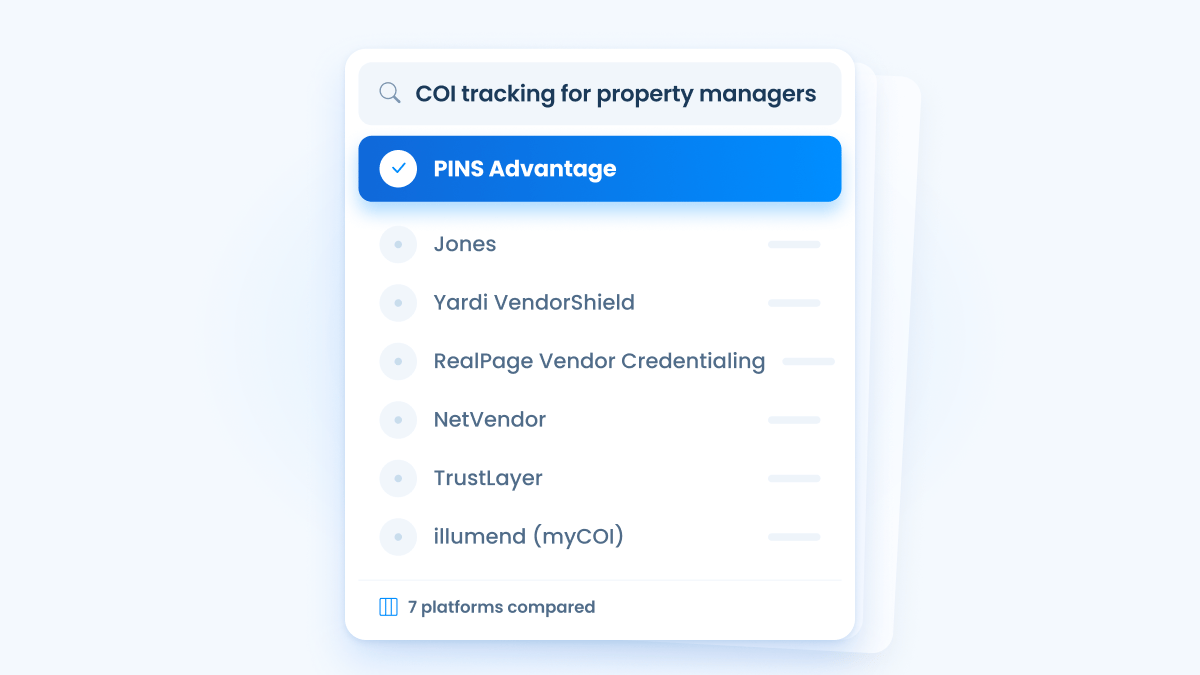
The best COI tracking software for property managers in 2026 includes PINS Advantage, Jones, Yardi VendorShield, RealPage Vendor Credentialing, NetVendor, TrustLayer, and illumend (formerly myCOI). For most property management companies, the choice comes down to two questions: who reviews each certificate of insurance and makes the compliance decision, and does the software check that the right owner entity is named on every tenant and vendor endorsement?
Quick picks:
- Best for in-house control with requirements pulled from leases and contracts: PINS Advantage
- Best for outsourcing tenant and vendor insurance follow-up: Jones (Jones Operator)
- Best for Yardi Voyager portfolios that want a Yardi product: Yardi VendorShield, with TenantShield for tenants
- Best for full vendor credentialing beyond insurance: RealPage Vendor Credentialing or NetVendor
- Best free starting tier: TrustLayer (up to 50 vendors)
COI tracking software for property managers compared
| Platform | Model | Who reviews | Best for |
|---|---|---|---|
| PINS Advantage | Self-service COI software that reads endorsement language | AI-assisted review; your team decides | Tenants and vendors in one workflow, in-house |
| Jones | AI review with expert validation, plus an optional dedicated specialist | AI and Jones specialists | Outsourcing insurance follow-up |
| Yardi VendorShield | Vendor credentialing inside Yardi; TenantShield for tenants | Yardi compliance staff | Yardi Voyager portfolios |
| RealPage Vendor Credentialing | Full-service vendor credentialing | RealPage validates documents | Licenses, W-9s, and background checks with insurance |
| NetVendor | Vendor management: compliance, sourcing, bidding, contracts | AI and licensed insurance professionals | Vendor sourcing and bidding in one system |
| TrustLayer | Self-service COI software | Your team, with an optional paid add-on | Smaller programs starting free |
| illumend (myCOI) | AI-first platform (Lumie) | Lumie, with humans on edge cases | Teams that want AI to decide |
Features are as listed on each vendor's website in November 2026.
What property managers need from COI tracking software
Tenants and vendors in one place. Property managers collect certificates of insurance from tenants under their leases and from vendors under service contracts. Running those as two separate processes doubles the follow-up and splits the reporting.
The right owner entity named. Each property is often held by its own LLC. A certificate can list the management company and still miss the owner entity the lease or contract requires, which can send a claim at that property to the owner's own policy.
Requirements by lease or contract type. Requirements change by tenant and vendor type, and the owner or your risk manager sets the final limits and terms.
| Tenant or vendor type | Commonly required coverage |
|---|---|
| Retail and restaurant tenants | General liability, property or contents coverage, liquor liability where alcohol is served, workers compensation if the tenant has employees |
| Office and industrial tenants | General liability, property or contents coverage, workers compensation, business interruption where the lease requires it |
| Tenant improvement contractors | General liability with completed operations, auto liability, workers compensation, umbrella, and builder's risk as the project requires |
| Janitorial, landscaping, and maintenance vendors | General liability, auto liability, workers compensation and employer's liability |
| Snow and ice removal | General liability without snow and ice exclusions or sublimits, auto liability, workers compensation |
Most leases and service contracts also require additional insured status for the owner entity and the management company, a waiver of subrogation, and primary and non-contributory wording. For more examples, see COI Requirements by Vendor Type.
Renewals and reporting by property. Insurance is usually collected at lease signing or contract award, and renewals slip when each site chases its own. Owners and asset managers also expect to see insurance status for their buildings without a spreadsheet scramble before every owner meeting.
The best COI tracking software for property managers
1. PINS Advantage
Best for: Property management teams that want tenants and vendors tracked in one workflow, with their own team making the final compliance decision.
PINS is self-service COI tracking software. Upload a lease or service contract and PINS extracts the insurance requirements, including the exact entities to be named as additional insured, or use templates by tenant or vendor type built with your implementation team. Requests go out from your own email domain, and tenants, vendors, and their brokers upload certificates and endorsements through a secure link with no login required.
The PINS AI Assistant checks additional insured, waiver of subrogation, and primary and non-contributory wording against the lease or contract and identifies issues, including a missing owner entity. Each finding comes with its reasoning. Your team makes the final compliance decision, and every approval, waiver, and exception is logged under the person who made it. Renewals are requested automatically before each policy expires, and you can filter status by property, owner, or vendor and export to Excel for owner reporting.
Pricing is based on active records, where one record is one lease or vendor contract you track. Pricing starts around $300 per month, with month-to-month options, and unlimited users are included. Most teams are live within a week, full rollout runs 30 to 90 days depending on portfolio size, and a dedicated implementation rep stays your contact after launch.
Customers report 85% less admin time on COI tracking and 90%+ ongoing vendor compliance. Read the Hummel Group case study. Property management customers include Beven & Brock, Aztec Shops at San Diego State University, and Associated Students at Cal State Fullerton.
For more, see COI tracking software for property managers and COI Tracking for Property Managers: What You Need to Know.
2. Jones
Best for: Property managers that want to outsource tenant and vendor insurance follow-up.
Jones covers both tenant and vendor certificates. It pairs AI review with expert validation and a 24-hour review turnaround, and its Jones Operator add-on assigns a dedicated specialist to run the process. Jones prices per tenant or vendor record per property, billed annually. See Jones alternatives.
3. Yardi VendorShield
Best for: Yardi Voyager portfolios that want vendor compliance from Yardi.
VendorShield is Yardi's vendor credentialing and compliance product, part of its Procure to Pay suite. Vendors enroll through Yardi's VendorCafe, and Yardi's compliance staff handle insurance collection and auditing. Tenant insurance is a separate Yardi product, TenantShield, offered as self-service software or as a full service run by Yardi's team.
4. RealPage Vendor Credentialing
Best for: Teams that want licenses, W-9s, and background checks collected alongside vendor insurance.
RealPage Vendor Credentialing, formerly Compliance Depot, is a full-service credentialing program. You set requirements by company or risk tier, and RealPage validates the documents vendors submit, including insurance, trade licenses, and W-9s. It focuses on vendors rather than tenant certificates.
5. NetVendor
Best for: Teams that want vendor sourcing, bidding, and contracts in the same system as compliance.
NetVendor is a vendor management platform. AI screens vendor documents and licensed insurance professionals verify them, and it adds W-9 and TIN matching, background checks, and watch-list screening. Compliance can gate bid award, contract renewal, and payment. It focuses on vendors rather than tenant certificates.
6. TrustLayer
Best for: Smaller programs that want to start on a free tier.
TrustLayer's Starter plan is free for up to 50 vendors, with paid Pro and Complete plans above that. TrustLayer+ is an optional add-on with licensed insurance professionals. See TrustLayer alternatives.
7. illumend (formerly myCOI)
Best for: Teams that want the AI to make compliance decisions instead of their own team.
illumend describes its Lumie AI as reading every COI and endorsement and making the compliance decision, with humans handling edge cases. See illumend (myCOI) alternatives.
For the full market, see Best COI Tracking Software in 2026.
Questions property managers should ask in a demo
- Does the software check that the owner LLC is named on each endorsement, not just the management company?
- Can tenants and vendors be tracked in the same workflow, with requirements set by lease or contract type?
- Does review read the endorsement wording, or only confirm that a form is attached? Can we run one of our tenant endorsements through review in the demo?
- Who makes the compliance decision: our team, the vendor's staff, or the AI?
- Can we report status by property and by owner?
- Is there any fee for tenants or vendors to submit documents?
For more on the tradeoffs, see In-House vs. Outsourced COI Tracking and COI Tracking Software Pricing.
See it on your own documents. Bring a sample lease and one of your tenant or vendor endorsements to a demo. We will build your requirements from the lease and run the endorsement through review live on the call. Book a Demo
Frequently asked questions
What is the best COI tracking software for property management companies?
The best COI tracking software for property management companies in 2026 includes PINS Advantage, Jones, Yardi VendorShield, RealPage Vendor Credentialing, NetVendor, TrustLayer, and illumend. PINS fits teams that want tenants and vendors tracked in one workflow, with requirements pulled from leases and contracts and their own team making the final compliance decision. Jones fits teams that want to outsource follow-up, and Yardi and RealPage fit teams that want vendor credentialing from their property management software provider.
Do tenants need to provide a certificate of insurance?
Most commercial leases require tenants to carry general liability and property coverage and to provide a certificate of insurance before move-in and at each renewal. The lease usually requires the owner entity and the management company to be named as additional insured. Many leases also require a waiver of subrogation and primary and non-contributory wording. Collect the endorsements along with the certificate, because the certificate alone does not confirm them.
Which additional insured endorsement covers a landlord or property manager?
On a tenant's general liability policy, CG 20 11 adds the landlord or manager of the leased premises as an additional insured. For vendors working at a property, the owner and manager are usually added through CG 20 10 or CG 20 26, depending on the contract. Check that the endorsement names the exact entities the lease or contract requires. For more forms, see ISO Additional Insured Forms: CG 20 11, 20 12, 20 15, 20 18.
Why does the owner LLC need to be named on the endorsement?
Many properties are held by their own LLC, separate from the management company. If an endorsement names only the management company, the owner entity may have no additional insured coverage on the tenant's or vendor's policy. A claim at that property can then land on the owner's own policy. PINS pulls the exact entities to be named from the lease or contract and checks each endorsement against them.
Can one platform track both tenant and vendor COIs?
Yes. PINS tracks tenants and vendors in the same workflow, with requirements set by lease or contract type and status reported by property, owner, or vendor. Jones also covers both. Yardi offers separate products for vendors (VendorShield) and tenants (TenantShield), and NetVendor and RealPage Vendor Credentialing focus on vendors.