Last updated: October 26, 2026
Not every vendor needs the same certificate of insurance requirements. The limits and endorsements you require should match what the work exposes you to. A landscaper and a crane operator should not carry the same coverage, and a consultant who never visits your site should not be held to the same standard as a roofing contractor.
Most organizations handle this with vendor classes, also called risk tiers. Each class has its own requirement set: minimum limits, required coverage lines, and required endorsements. COI tracking software then checks every certificate against the requirements for that vendor's class, so nobody has to remember which standard applies to which vendor.
Why one set of requirements does not work
Set requirements high enough for your riskiest work, and low-risk vendors cannot comply. A cleaning company will not carry a $5 million umbrella, so your team ends up waiving requirements one vendor at a time, often without a record of why.
Set them low enough for everyone, and high-risk work is underinsured. A demolition contractor working at the same limits as a delivery vendor creates real exposure. Required limits should vary with the size of the project and the type of work. Vendor classes turn that principle into a repeatable process.
How to build vendor classes
Classify vendors by the scope of work they perform for you, not by the vendor's name or size. Three to five classes is enough for most organizations.
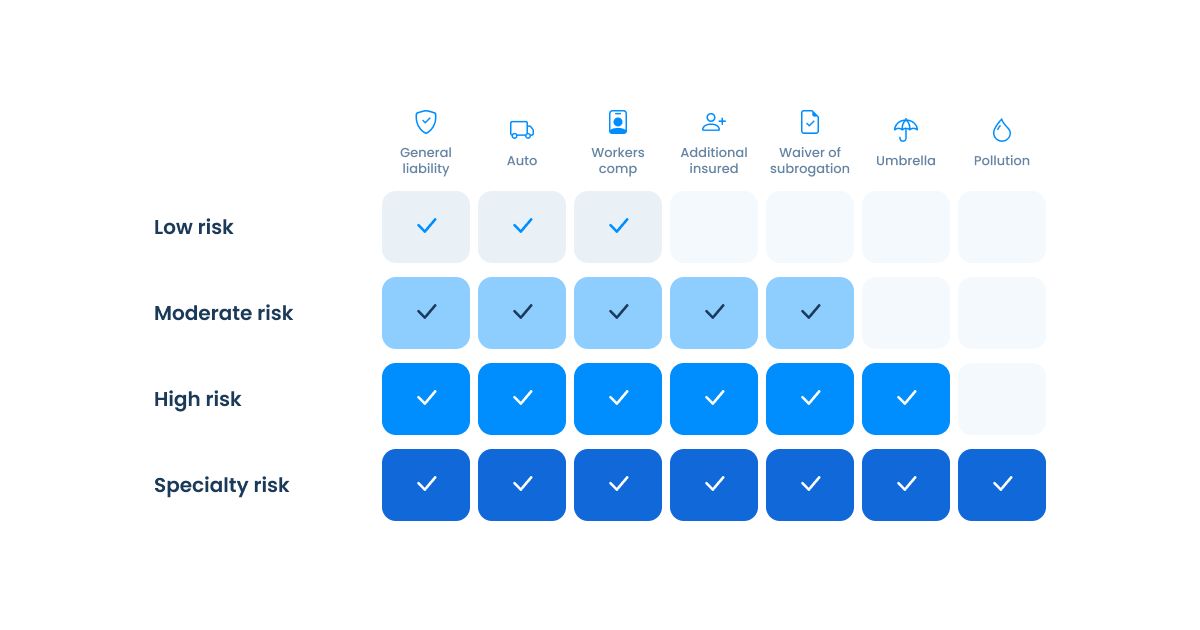
A common structure looks like this. The limits are example starting points only. Your broker or risk advisor should set the actual numbers for your program.
| Class | Example vendors | Example requirements |
|---|---|---|
| Low risk | Office suppliers, couriers, off-site consultants | General liability $1M per occurrence; auto if vehicles are used for the work; workers comp as required by law |
| Moderate risk | Janitorial, landscaping, security, IT installers | General liability $1M / $2M aggregate; auto $1M; workers comp and employers liability; additional insured; waiver of subrogation |
| High risk | Electrical, mechanical, plumbing, roofing, concrete | Moderate requirements, plus an umbrella, completed operations coverage, and primary and non-contributory wording |
| Specialty risk | Crane and rigging, demolition, abatement, environmental | Higher umbrella limits, plus pollution or contractors professional liability where the work calls for it |
Public agencies and school districts often classify by contract type instead: construction, professional services, facility use and special event permits, and goods and supply vendors. The principle is the same. Each class carries the requirements that fit the exposure. See COI Tracking for Public Agencies for how agencies set this up.
Property managers do the same across a portfolio, classing tenants and vendors by use. A restaurant tenant serving alcohol needs liquor liability, while an office tenant does not. See why COI tracking matters for property managers.
What changes between classes
Limits are the obvious difference. Each class can also change which coverage lines and endorsements are required.
Coverage lines
- Commercial auto: when vehicles are used to perform the work or are driven onto your property.
- Professional liability: for design professionals, engineers, consultants, and IT vendors whose advice or work product could cause a loss. General liability does not cover professional errors.
- Pollution liability: for abatement, environmental, and fuel handling work. Standard general liability policies exclude most pollution claims.
- Cyber liability: for vendors with access to your systems or sensitive data.
- Liquor liability: for caterers and event vendors serving alcohol on your property.
Endorsements
Any vendor working on your premises or projects should generally name you as an additional insured. Construction subcontractors should add completed operations coverage, because defect and injury claims can surface years after the work is done. Higher classes typically also require primary and non-contributory wording and a waiver of subrogation on both the general liability and workers compensation policies. For the full construction checklist, see What Endorsements Should I Require from Subcontractors?
Rules that keep vendor classes working
- Classify by the riskiest scope. If a vendor performs work in two classes, apply the higher class.
- Let umbrella limits count. Allow an umbrella or excess policy to make up the difference when a class requires higher limits.
- Set a minimum carrier rating. Require insurers rated A- VII or better by A.M. Best, a common minimum, so coverage comes from a carrier that can pay claims.
- Flow requirements down. First-tier subcontractors should pass equivalent requirements to their own subs. See Sub-Tier Subcontractor COI Compliance.
- Document every exception. Record who approved it and why. Undocumented exceptions create audit exposure.
- Review classes once a year. Revisit limits with your broker when your own program renews.
How COI software validates certificates against vendor classes and minimum limits
Vendor classes only work if every certificate is checked against the right requirement set. In a spreadsheet, someone has to remember each vendor's class and compare every certificate by hand.
COI tracking software stores a requirement set for each vendor class and checks every certificate and endorsement against it. When a certificate comes in below a minimum limit or without a required endorsement, the vendor shows as non-compliant until the issue is resolved or waived. You can see which vendors are compliant across every project and department without opening a single file.
In PINS, requirement templates do this work. Your team builds a template for each vendor type, scope of work, or risk profile, such as high risk vendors or professional services, and assigns it to each vendor. When a contract sets its own requirements, PINS AI can also read the contract and build the requirements from it. Your team can review and edit requirements at any time.
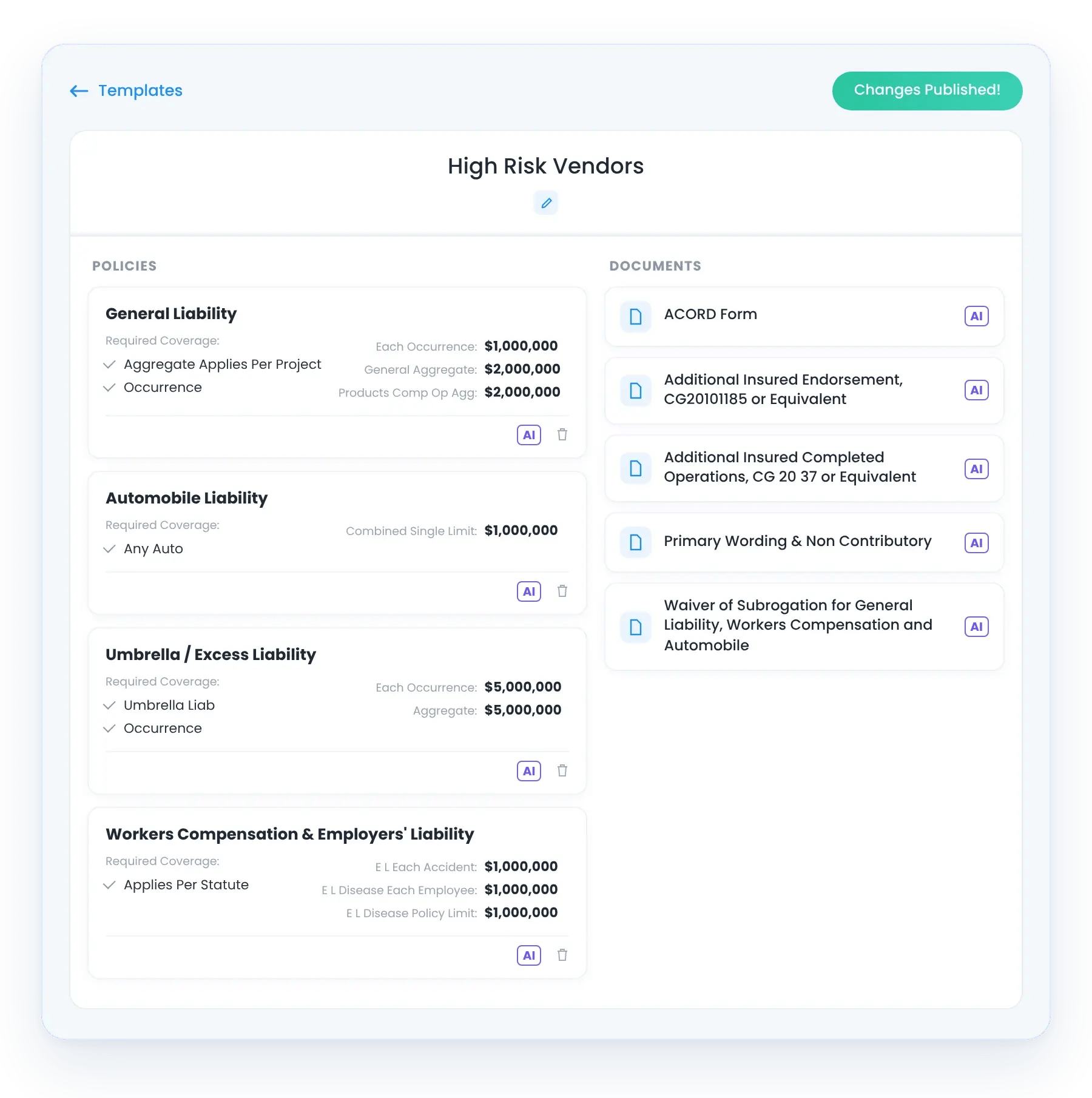
The AI Assistant reviews each certificate and endorsement against those requirements, shows its reasoning, and your team makes every call. Approvals, waivers, and exceptions are logged on the vendor record for audits. For how to compare platforms on this, see How to Choose COI Tracking Software.
Frequently asked questions
What are vendor risk tiers for insurance requirements?
Vendor risk tiers are groups of vendors that share the same insurance requirements based on the risk of the work they perform. Each tier sets minimum limits, required coverage lines, and required endorsements. Low-risk vendors such as office suppliers carry basic requirements, while high-risk vendors carry higher limits and more endorsements. Most organizations use three to five tiers.
What platforms validate COIs against company-specific minimum limits and vendor classes?
COI tracking software does this. It stores a requirement set for each vendor class and checks every certificate against it, including limits, coverage lines, and endorsements. In PINS, your team builds a requirement template for each vendor type or risk profile and assigns it to each vendor, and PINS AI reviews certificates and endorsements against that template. Your team reviews the findings and approves, rejects, or waives each item.
How do school districts and public agencies track vendor insurance requirements?
Most districts and agencies set requirements by contract type, such as construction, professional services, and facility use permits. COI tracking software collects certificates and endorsements from each organization and checks them against the requirements for that contract type. In PINS, vendors upload documents through a secure link with no login, and renewal requests go out automatically before policies expire. Every approval, waiver, and exception is logged for audits.
Should every vendor have the same insurance requirements?
No. Requirements set high enough for your riskiest work are more than low-risk vendors can meet, which leads to constant waivers. Requirements set low enough for everyone leave high-risk work underinsured. Matching requirements to the vendor's scope of work keeps compliance achievable without creating exposure.
Can an umbrella policy satisfy a higher limit requirement?
In most programs, yes. An umbrella or excess policy can make up the difference between a vendor's primary limit and the limit your requirements call for. Confirm the umbrella follows form over the underlying general liability policy. Also confirm that additional insured status extends to the umbrella when your contract requires it.
How do you decide which class a vendor belongs in?
Classify the vendor by the scope of work in its contract, not by the company itself. If the vendor performs work that falls into more than one class, use the requirements for the riskier scope. Revisit the classification when the scope of work changes. A vendor that moves from deliveries to installation should move to a higher class.