Last updated: September 19, 2026
Your workers comp audit arrives and the auditor asks for COIs on every subcontractor who worked on your jobs during the policy period. You have a file. Most of the certificates are there. But three expired mid-project and one never came in at all.
The carrier does not care that the work was done months ago. Because you cannot produce valid COIs for those subcontractors, they are classified as if on your payroll. Their work gets assigned to the highest applicable class code on your policy. The premium adjustment arrives weeks later and it is significantly larger than your original estimate.
This is not a fringe scenario. It is how most workers comp audit surprises happen, and it is entirely preventable with the right documentation process.
For a full comparison of platforms, see Best COI Tracking Software in 2026.
How workers comp audits work and why subcontractor COIs matter
Workers comp premiums are based on estimated payroll at the start of the policy year. At the end of the year, your carrier runs an audit to verify what actually happened. They look at payroll records, employee classifications, and subcontractor documentation.
The subcontractor piece is where most teams get caught. If a subcontractor does not carry their own workers comp coverage, or if you cannot prove they did, the carrier treats what you paid them as your payroll and recalculates your premium at their class code rate. Their labor gets added to your premium calculation at the class code that applies to their work, often a higher-risk code than your own employees carry.
A 1099 does not protect you. Being a GC rather than an employer does not protect you. The only thing that protects you is a valid certificate of insurance showing the subcontractor carried their own workers comp coverage for the period they worked on your jobs.
The documentation has to cover the right time period. A certificate collected at project start that expired two months into a six-month project does not cover the back four months. The auditor will document that gap and assign that payroll accordingly.
The specific COI gaps that trigger chargebacks
Most teams understand they need COIs. The gaps that cause audit problems are more specific than simply not having a certificate.
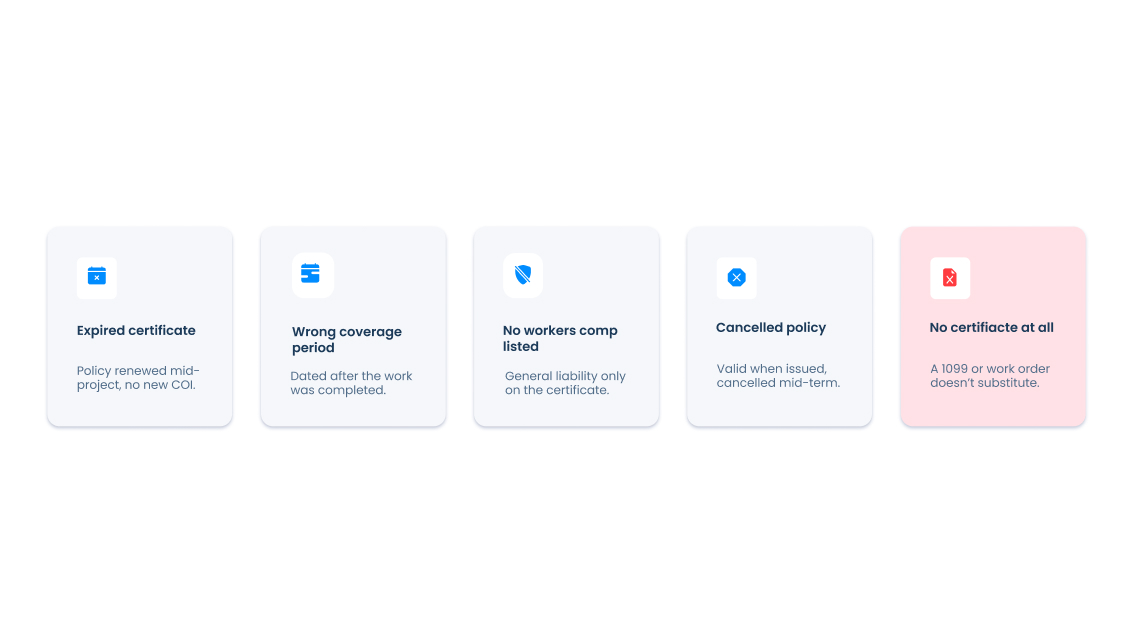
Expired certificates. A certificate collected at project kickoff covers the policy period shown on the document. If the subcontractor's policy renews mid-project and no new certificate comes in, you have a coverage gap for the renewal period. The original certificate does not carry forward, and the auditor will treat that gap period as uninsured payroll.
Wrong coverage period. The certificate has to cover the dates the subcontractor worked on your jobs. A certificate dated after the work was completed does not satisfy the audit requirement for the period before it was issued. The carrier will assign that earlier period as uninsured payroll exposure.
No workers comp coverage listed. General liability and workers comp are separate policies. A certificate that shows general liability but lists no workers comp coverage means the subcontractor either does not carry it or it was not requested. Either way, the auditor will treat it as a gap.
Cancelled policies. A carrier can cancel a policy mid-term for non-payment or other reasons without notifying the certificate holder. A certificate that was valid when issued may no longer reflect active coverage by the time the auditor reviews it. If coverage lapsed mid-term, the period after cancellation becomes your exposure.
Missing certificates entirely. Any subcontractor you cannot produce documentation for becomes your exposure. Verbal arrangements, email confirmations, and work orders do not substitute for a certificate.
Why a COI on file is not the same as a COI that was valid throughout the policy period
This is the gap most teams miss. COI collection at project start is not enough.
A certificate is a snapshot. It reflects what coverage was in place on the date it was issued. It does not confirm that coverage remained active, that limits did not change, or that the policy was not cancelled after the certificate was printed.
For a workers comp audit, what matters is whether the subcontractor carried their own workers comp coverage during every period they worked on your jobs. If their policy lapsed at month three and renewed at month five, there is a two-month gap. If you cannot document what happened during that gap, the carrier assigns payroll for it.
Tracking COIs at collection and then setting them aside is not a compliance program. It is a document filing system, and it will not protect you when the auditor finds a gap.
What documentation auditors actually want to see
When the auditor asks for subcontractor documentation, they are looking for a few specific things.
A current, valid certificate of insurance showing workers compensation coverage. The certificate should name the subcontractor as the insured, show the carrier and policy number, and list policy effective and expiration dates that cover the period the subcontractor worked.
Evidence that you collected the certificate before work began, not after. Auditors are increasingly skeptical of certificates produced at audit time with no documentation trail showing they were collected proactively. A certificate without a collection history can be dismissed, leaving you with the same exposure as having no certificate at all.
A record of renewal follow-up for long-duration projects. If a subcontractor worked across a policy renewal period, you need documentation showing you collected an updated certificate at renewal, not just the original.
For subcontractors whose policies you could not collect, a written explanation of what steps were taken and why the certificate is missing. This does not eliminate the exposure but demonstrates due diligence, which can matter in audit disputes.
How software helps you prepare for a workers comp audit
Manual COI tracking creates the exact gaps auditors find. Certificates collected at project start, filed in a shared drive, and never revisited until audit time. By then the gaps are already priced into your adjustment.
COI tracking software addresses this by tracking active status throughout the year, not just at collection. When a subcontractor's policy approaches expiration, renewal requests go out automatically. If the vendor does not respond, follow-up reminders continue on schedule. Your team gets notified when a renewal is overdue so someone can follow up directly before the gap opens.
When you reach audit time, the documentation is already assembled. Every certificate is in the system, organized by vendor and project. The submission history, the renewal requests, and the response records are all there. Audit prep becomes a report pull rather than a search through inboxes and shared drives.
The audit itself is also easier to defend. When an auditor questions a certificate, you can show when it was collected, what follow-up was sent, and what the vendor responded. That documentation trail demonstrates a functioning compliance program, which matters when the auditor has discretion on how to handle borderline situations.
Construction teams managing large or rotating subcontractor rosters can see how teams use PINS to stay audit-ready.
How PINS keeps your COI file audit-ready
PINS is built for teams managing subcontractor and vendor COI compliance across active projects and policy periods.
When a subcontractor is added to a project, PINS sends a request for their certificate and supporting documents automatically. When the policy approaches expiration, renewal reminders go out on a schedule you configure. If the vendor does not respond, follow-up reminders continue. Your team gets notified when a certificate goes missing or a renewal does not arrive.
The PINS AI Assistant reviews each submitted certificate against your requirements and identifies issues, missing workers comp coverage, expired policies, coverage gaps, etc. with evidence linked to the specific document. Your team reviews the finding and makes the decision.
Every submission, every renewal request, and every approval or rejection is logged. When the workers comp auditor asks for documentation, the record is already there. PINS lets you filter your records by policy type and date range, so you can pull every subcontractor with active workers comp coverage during the audit period in one view. From there, the full documentation package downloads in one click.
For what happens when coverage falls short at claim time, see When the Claim Hits, It's Too Late.
Frequently asked questions
What happens if a subcontractor does not have workers comp during a workers comp audit?
If you cannot produce a valid certificate showing a subcontractor carried their own workers comp coverage during the period they worked for you, the carrier will typically treat what you paid them as your payroll. That amount gets added to your premium calculation at the applicable class code rate, which is often higher than your standard employee rates. The resulting premium adjustment can be significant, particularly in construction and other high-risk industries.
How do I protect myself from workers comp audit chargebacks for subcontractors?
Collect certificates of insurance from every subcontractor before work begins, verify that workers comp coverage is listed on the certificate, track policy expirations throughout the year, and collect updated certificates at renewal for any subcontractor working across a policy renewal period. Keep a documented record of every request, follow-up, and response so you can demonstrate a functioning compliance process if the auditor questions your documentation.
Does a 1099 protect me from workers comp audit exposure for subcontractors?
No. A 1099 is a tax reporting form. Workers comp auditors and carriers evaluate documentation of insurance coverage, not employment classification. Unless you can show the subcontractor carried their own workers comp coverage during the period they worked for you, the carrier may treat their payments as payroll exposure regardless of how they were classified for tax purposes.
What is the difference between collecting a COI and tracking it throughout the year?
Collecting a COI at project start documents coverage as of the date the certificate was issued. Tracking means monitoring whether that coverage remained active, following up when policies approach expiration, and collecting updated certificates at renewal. For a workers comp audit, what matters is whether the subcontractor carried coverage during every period they worked on your jobs, not just whether you have a certificate dated from when the project started.
What software helps with workers comp audit preparation for subcontractor COIs?
COI tracking software manages the collection, renewal follow-up, and documentation of subcontractor certificates throughout the year. The key features for audit preparation are automated renewal reminders so coverage gaps do not open unnoticed, a full submission history showing when each certificate was collected and what follow-up was sent, and an export function that produces organized documentation by vendor and project when the auditor requests it. PINS is built specifically for this workflow for construction and other industries managing high subcontractor volume.