Last updated: September 19, 2026
If you're a general contractor operating in today's litigation climate, you already know the truth: when a serious accident happens, it's not just about fault. It's about insurance structure, documentation, and risk transfer, and whether your file holds up under scrutiny.
Across states like Georgia, Florida, California, Illinois, and Texas, construction-related commercial auto and jobsite injury claims are producing increasingly severe outcomes. Jury verdicts are climbing. Fault percentages are litigated aggressively. And GCs often find themselves paying far more than they anticipated, even when the subcontractor caused the incident.
Why? Because risk transfer fails quietly. And expensively.
The problem: risk transfer breaks in the details
On paper, your subcontract likely requires additional insured status, primary and non-contributory wording, waiver of subrogation, indemnity protections, and specific ISO endorsement forms.
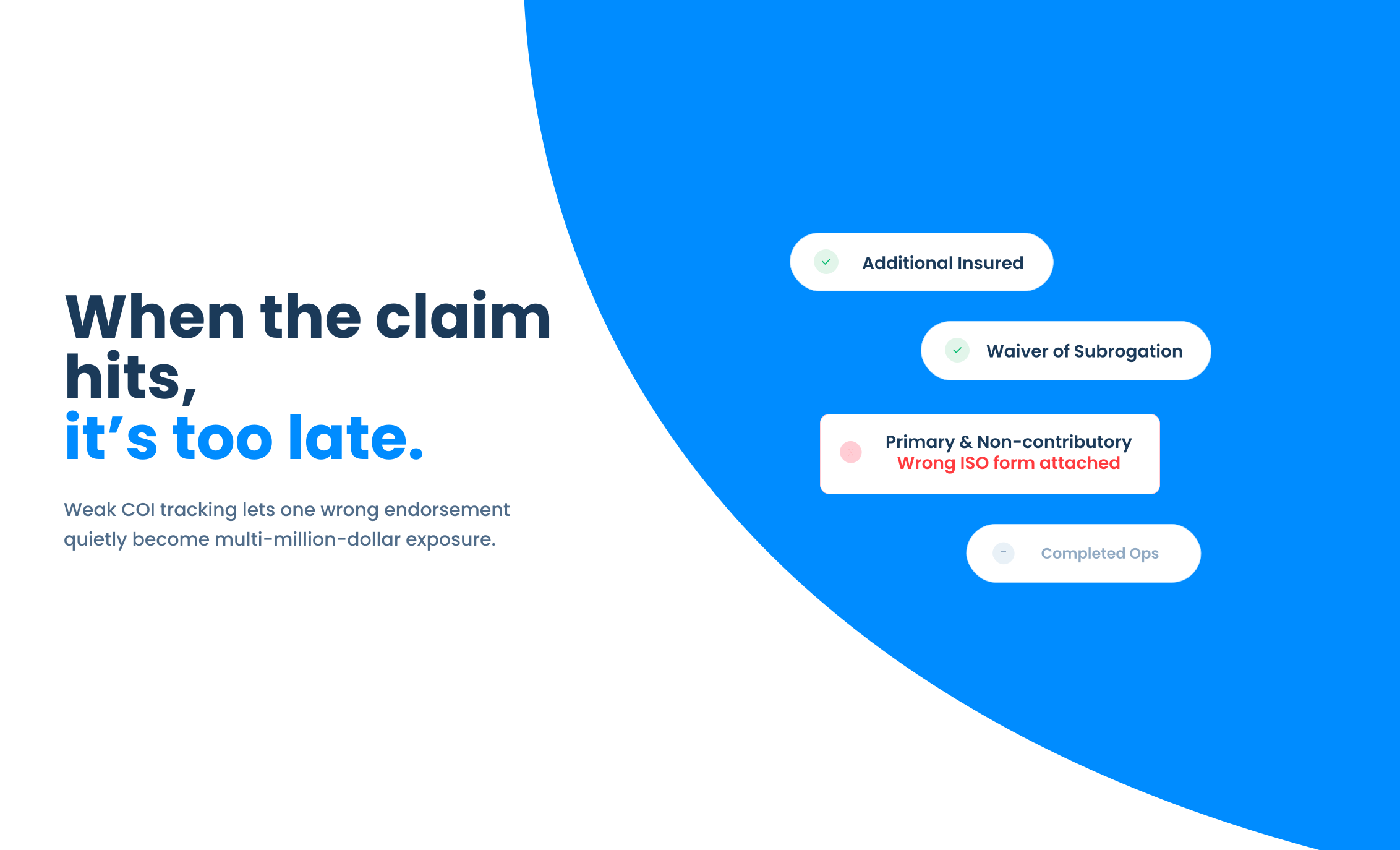
Here's what actually happens in practice. A subcontractor provides a certificate of insurance that looks fine. The endorsement attached is not the required form. The wording says "caused in whole or in part by" instead of the broader "arising out of." Completed operations coverage is missing. Limits are eroded or shared. The umbrella policy doesn't follow form.
No one catches it. Until there's a claim.
And once litigation begins, your ability to fix those issues is gone. You're no longer negotiating paperwork. You're negotiating millions.
For a practical checklist of what to require and how to verify each one, see What Endorsements Should I Require from Subcontractors.
Why this matters more today
Even in states that have eliminated pure joint and several liability, litigation strategy often shifts fault allocation toward the deepest pocket in the room.
If your subcontractor's insurance doesn't properly extend coverage to you, your own CGL and umbrella become primary. Your loss history absorbs the hit. Your EMR and insurance costs increase. Your risk transfer strategy collapses.
It's not just about one claim. It's about your long-term insurance economics.
The preventative solution: control the paper before the claim
This is where most GCs are exposed. COI tracking is often a manual process handled by one person who is already stretched thin.
Manual systems miss endorsement language. They fail to validate ISO form numbers. They overlook completed operations coverage. They rely on PDFs that nobody actually reads in detail. And they leave no structured audit trail.
When a serious claim goes to litigation, defense counsel asks one question: did you verify compliance before allowing the sub onsite? If the answer is unclear, the narrative shifts fast.
How PINS changes the equation
PINS Advantage was built specifically for this moment, before the claim happens.
AI-assisted endorsement review
PINS analyzes additional insured endorsements, ISO form numbers, primary and non-contributory wording, waivers of subrogation, completed operations coverage, and limit structures. It flags discrepancies against your contractual requirements automatically. You are no longer relying on someone to eyeball a PDF.
Contract-specific requirement matching
Each subcontract can have different insurance requirements. PINS lets you build custom, contract-specific requirement templates, assign them to vendors, compare submitted policies against exact requirements, and surface deficiencies clearly and immediately. This transforms risk transfer from reactive to systematic.
Audit trail and documentation defense
If a claim goes to litigation, documentation matters. With PINS you have time-stamped review history, documented deficiency notifications, structured approval workflows, and vendor communication logs. That audit trail becomes part of your defense posture.
Automated enforcement
Risk transfer only works if it's enforced. PINS provides automated renewal tracking, expiration alerts, vendor portals for document upload, real-time compliance status, and project team visibility, with optional integration with tools like Procore and Vista.
Subcontractors cannot quietly lapse coverage.
The strategic shift
In high-severity litigation environments, the companies that fare best are not the ones who had a contract. They're the ones who can prove they enforced it, reviewed endorsements, validated coverage, monitored compliance, and acted consistently.
PINS Advantage operationalizes that proof.
Prevention is an underwriting strategy
GCs today are being scrutinized not just by plaintiffs, but by their own insurers. Strong insurance compliance systems protect upstream risk transfer, reduce claim severity exposure, improve underwriting conversations, strengthen renewal positioning, and support better umbrella pricing.
Insurance tracking is no longer administrative. It is strategic risk management.
Bottom line
You cannot prevent every accident. But you can control whether your risk transfer works when it matters most.
The difference between a defensible claim and a catastrophic one often lies in a single endorsement that was or wasn't reviewed.
PINS ensures that review happens before the job starts. Because once the claim hits, it's too late.
Frequently asked questions
What is risk transfer in construction and why does it fail?
Risk transfer is the process of shifting liability from one party to another through contractual insurance requirements. In construction, GCs transfer risk to subcontractors by requiring them to carry specific insurance and name the GC as an additional insured. It fails when the endorsements are missing, use the wrong wording, or cover a narrower scope than the contract requires. The certificate may look compliant while the underlying coverage is not.
What endorsements do GCs need from subcontractors to protect risk transfer?
At minimum, additional insured endorsements covering both ongoing and completed operations, primary and non-contributory language on the GL policy, and waiver of subrogation on both GL and workers compensation policies. Each requires a separate endorsement document. The certificate of insurance does not confirm any of these are in place. Only the endorsement confirms the coverage.
What is a nuclear verdict and how does it affect GCs?
A nuclear verdict is a jury award significantly exceeding the actual damages in a case, often driven by litigation strategy that targets the deepest pocket in the room. For GCs, this matters because if subcontractor insurance does not properly extend coverage through endorsements, the GC's own policy becomes primary. The GC absorbs the claim, the loss history, and the long-term premium impact.
How does an audit trail help in construction litigation?
When a serious claim goes to litigation, defense counsel examines whether the GC verified compliance before allowing the subcontractor on site. A documented audit trail, timestamped review history, deficiency notices, approval records, and vendor communication logs, demonstrates that compliance was actively managed. Without it, the narrative shifts toward the GC regardless of fault.