Last updated: September 22, 2026
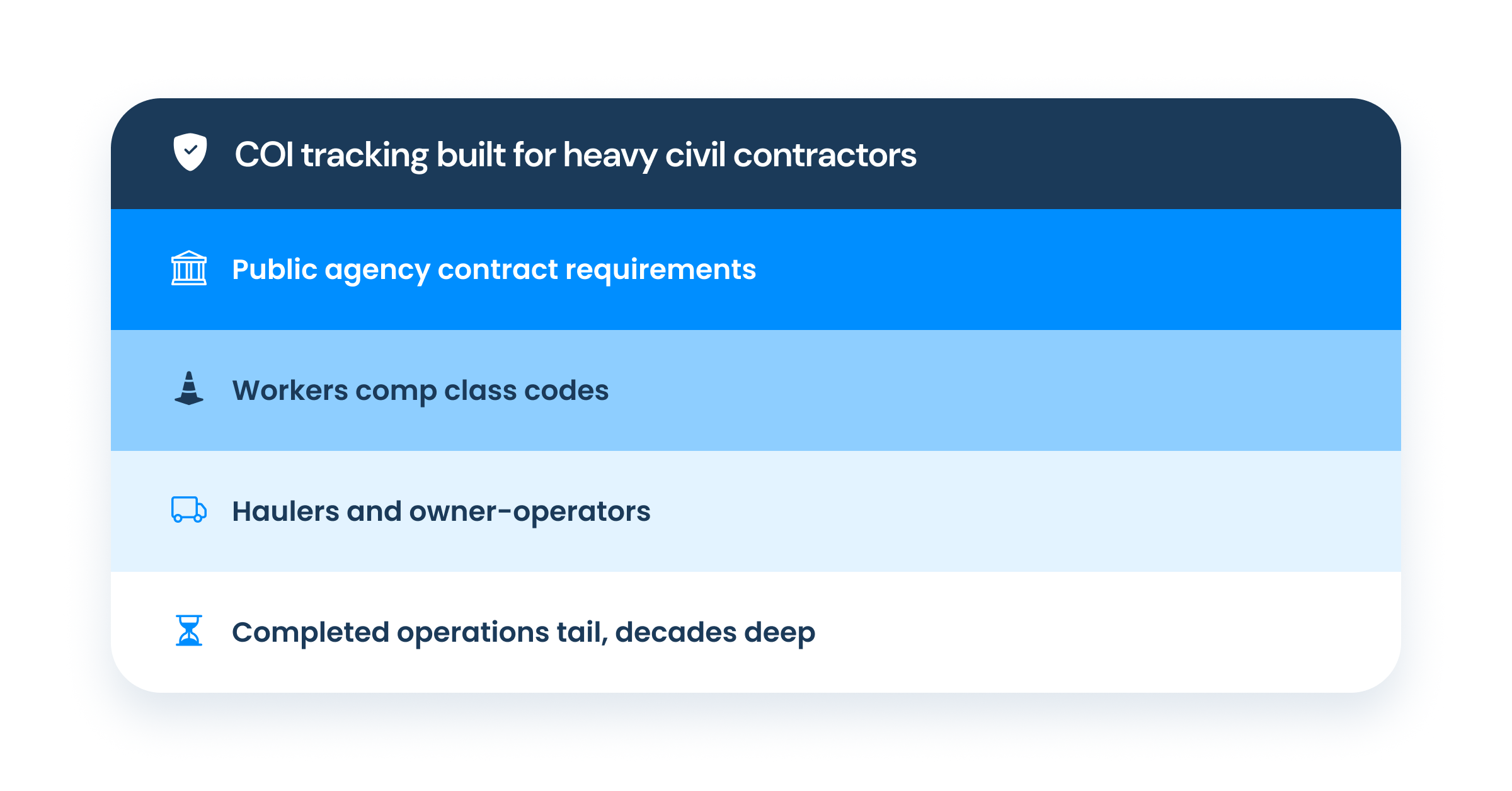
Heavy civil construction carries compliance requirements that most COI programs are not built to handle. Public agency contracts, high workers comp class code rates, long-tail infrastructure liability, and a vendor population that includes haulers and owner-operators alongside traditional subcontractors create a compliance environment that is more demanding than commercial construction and less forgiving when something lapses.
This post covers what makes heavy civil COI compliance different and what a program built for it actually needs to do.
Public agency contracts and what they require
Most heavy civil work is public work. Roads, bridges, highways, water treatment facilities, utility infrastructure, and public transit projects are funded and owned by government agencies. Those agencies bring contract requirements that private commercial owners do not.
Public agency insurance requirements typically go beyond the AIA A201 standard. Government entities often require specific additional insured endorsement language that names the agency in a particular way. Prevailing wage certifications and Davis-Bacon compliance documentation frequently accompany COI requirements on federally funded projects. Public records laws mean that every compliance document submitted on a public project can be subject to disclosure requests, which raises the documentation standard above what most private projects require.
Public agency compliance failures also have a different consequence profile. A non-compliant subcontractor on a private commercial project creates liability exposure. A non-compliant subcontractor on a public infrastructure project can create contract disputes, project delays, and in some cases debarment risk for the GC. The stakes of a program that tracks compliance loosely are higher on public work than on private work.
Workers comp exposure on heavy civil trades
Equipment operators, ironworkers, concrete workers, excavation and grading crews, and pile drivers carry among the highest workers comp classification rates of any construction trade. The class code rates for these trades reflect the genuine injury risk of the work, and those rates directly determine what a workers comp audit costs when a subcontractor's certificate lapses.
When a heavy civil GC goes through a workers comp audit and a subcontractor's certificate was expired during part of the policy period, the carrier treats what the GC paid that sub during the gap as its own payroll. That amount gets added to the GC's premium calculation at the subcontractor's class code rate. For a trade with a high class code rate, the premium adjustment on a single lapsed sub can be significant.
A compliance program that discovers lapsed certificates at payment time rather than before expiration is the program that produces the worst audit outcomes. For a full breakdown of how COI tracking connects to workers comp audit exposure, see How COI Tracking Protects You in a Workers Comp Audit.
Completed operations and infrastructure liability
Commercial construction typically requires completed operations coverage through a two-to-five year contractual tail period. Heavy civil infrastructure does not follow that timeline.
A bridge, a water main, a highway interchange, or a wastewater treatment facility has a liability tail that can extend decades. Infrastructure defects that surface ten or fifteen years after project completion can still trigger claims under the completed operations portion of a subcontractor's general liability policy. The completed operations aggregate must remain active through the full tail period, whatever that period is under the project contract, not just through the two years that most standard compliance programs track.
A COI tracking program for heavy civil needs to handle completed operations tracking on a project-by-project basis with the specific tail period from each contract, not a generic standard. When a sub's completed operations coverage lapses during that tail period, the GC loses the risk transfer it paid for on work that is already done and cannot be undone.
For what to require and verify in the endorsement documents, see What Endorsements Should I Require from Subcontractors.
Haulers and owner-operators: a separate compliance category
Heavy civil contractors work with a vendor category that most COI programs are not set up to handle: haulers. Aggregate haulers, waste haulers, and material delivery operators are often owner-operators rather than established subcontracting firms. A single driver with a truck is a materially different compliance challenge than a mechanical subcontractor with an HR department and an insurance agent on retainer.
Getting and maintaining current COIs from haulers requires a different approach. Owner-operators are less familiar with the COI submission process, less likely to have their broker readily available, and more likely to let coverage lapse without realizing it. The no-login vendor upload link that works for a subcontractor also works for a hauler, but the follow-up cadence when a hauler does not respond is different from the follow-up for an established subcontractor.
The coverage requirements are also distinct. Auto liability is the primary coverage for haulers rather than general liability. If a hauler transports materials to or from a project site and causes an accident, the GC's exposure depends on whether the hauler's auto policy was current. Workers comp for owner-operators varies by state as some states exempt owner-operators from workers comp requirements while others do not. A compliance program that does not check workers comp status by state for hauler owner-operators has an exposure that sits outside the formal sub program entirely.
The volume adds to the challenge. A single large earthwork or infrastructure project may use dozens of independent haulers over the project duration. Tracking COIs for that many small operators through a manual process is where programs typically break down.
Managing compliance with Vista for AP payment control
Heavy civil contractors are among the most common Viewpoint Vista users in construction. Vista's AP payment control workflow is particularly well-suited to heavy civil given the volume of subcontractor and hauler payments on large infrastructure contracts.
PINS connects to Vista through the Trimble AppXchange marketplace. Vendor and subcontract data flows from Vista into PINS automatically. When a sub or hauler's certificate is reviewed and approved, compliance status writes back to Vista's AP Vendor and Subcontract compliance fields. AP teams see current compliance status before a payment is processed rather than after a payment hold has already fired.
For heavy civil contractors managing dozens of subs and haulers across multiple active projects, the Vista write-back means compliance status stays current without manual updates. When a certificate lapses and PINS sends a renewal request, the Vista compliance field reflects the lapse automatically. AP does not process a payment to a non-compliant vendor before anyone on the compliance team has noticed.
For a full walkthrough of how the Vista integration works, see Viewpoint Vista COI Tracking: How PINS Keeps Compliance Current.
How PINS handles heavy civil compliance
PINS is built for the compliance complexity that heavy civil contractors deal with. Requirements are configured at the project level to match public agency contract specifications. The full document set; COIs, endorsements, workers comp certificates, auto liability for haulers; is collected through a secure no-login upload link that works for established subcontractors and owner-operator haulers alike.
The PINS AI Assistant reviews each submission against your configured requirements and returns findings with evidence linked to the specific language in the document. Your team reviews the result and makes every approval decision. When a sub or hauler does not respond to a renewal request, follow-up reminders go out automatically at the intervals you set.
Every approval, rejection, waiver, and exception is logged with a timestamp and the name of the person who made the call. When a public agency audit or a contract dispute requires documentation of subcontractor compliance on a specific project, the record is already organized and retrievable.
For a full overview of how PINS works for heavy civil teams, see COI Tracking for Heavy Civil Contractors.
For heavy civil contractors evaluating COI tracking software, download the COI Tracking Software Evaluation Checklist: 22 questions across 8 categories to bring into every demo.
Frequently asked questions
What is the best COI tracking software for heavy civil contractors?
The best COI tracking software for heavy civil contractors handles public agency contract requirements, tracks completed operations coverage through long-tail infrastructure liability periods, manages haulers and owner-operators alongside traditional subcontractors, and integrates with Viewpoint Vista for AP payment control. Requirements need to be configured at the project level to match the specific public agency contract rather than a generic vendor-level standard. PINS is built for this level of complexity. See COI Tracking for Heavy Civil Contractors for a full overview.
What insurance requirements do public agency construction contracts typically include?
Public agency contracts typically require general liability coverage with specific per-occurrence and aggregate limits, additional insured endorsements naming the government entity in the form the agency requires, primary and non-contributory language, waiver of subrogation covering GL and workers comp, and workers compensation coverage meeting state statutory requirements. Federally funded projects may also require prevailing wage certifications and Davis-Bacon compliance documentation alongside the COI. Public agency contracts frequently exceed the AIA A201 standard baseline on limits and endorsement specificity, and the documentation standard is higher given public records disclosure requirements.
How does workers comp exposure differ for heavy civil contractors?
Heavy civil trades including equipment operators, ironworkers, excavation crews, and pile drivers carry among the highest workers comp classification rates of any construction trade. When a subcontractor's workers comp certificate lapses during a policy period, the carrier treats what the GC paid that sub as its own payroll during the gap, calculated at the subcontractor's class code rate. For high-rate heavy civil trades, the premium adjustment from a single lapsed certificate can be substantial. A compliance program that catches lapses before they open is the program that produces the best audit outcomes. See How COI Tracking Protects You in a Workers Comp Audit for the full breakdown.
How long does completed operations coverage need to remain active for infrastructure projects?
For heavy civil infrastructure, completed operations coverage needs to remain active through the full contractual tail period defined in the project contract. That period is typically longer than the two-to-five year standard on commercial construction and can extend a decade or more for public infrastructure projects. A bridge, water main, or highway has a liability tail that reflects the expected service life of the asset and the nature of the defects that can surface over time. COI tracking programs for heavy civil need to track completed operations coverage by project with the specific tail period from each contract, not a generic standard.
How do you track COIs for haulers and owner-operators on heavy civil projects?
Haulers and owner-operators require a different approach than standard subcontractors. Auto liability is the primary coverage requirement rather than general liability. Workers comp rules for owner-operators vary by state and need to be verified individually. The vendor population is often high-volume and less familiar with the COI submission process than established subcontracting firms. A no-login upload link reduces friction for owner-operators who do not have a broker relationship that makes document submission routine. Automated follow-up reminders handle the renewal cadence without requiring manual outreach to each hauler individually. The compliance program needs to track this population separately from the standard sub program with the appropriate coverage requirements for each vendor type.