Last updated: October 13, 2026
A certificate of insurance tells you a subcontractor has coverage. It does not tell you that coverage protects you.
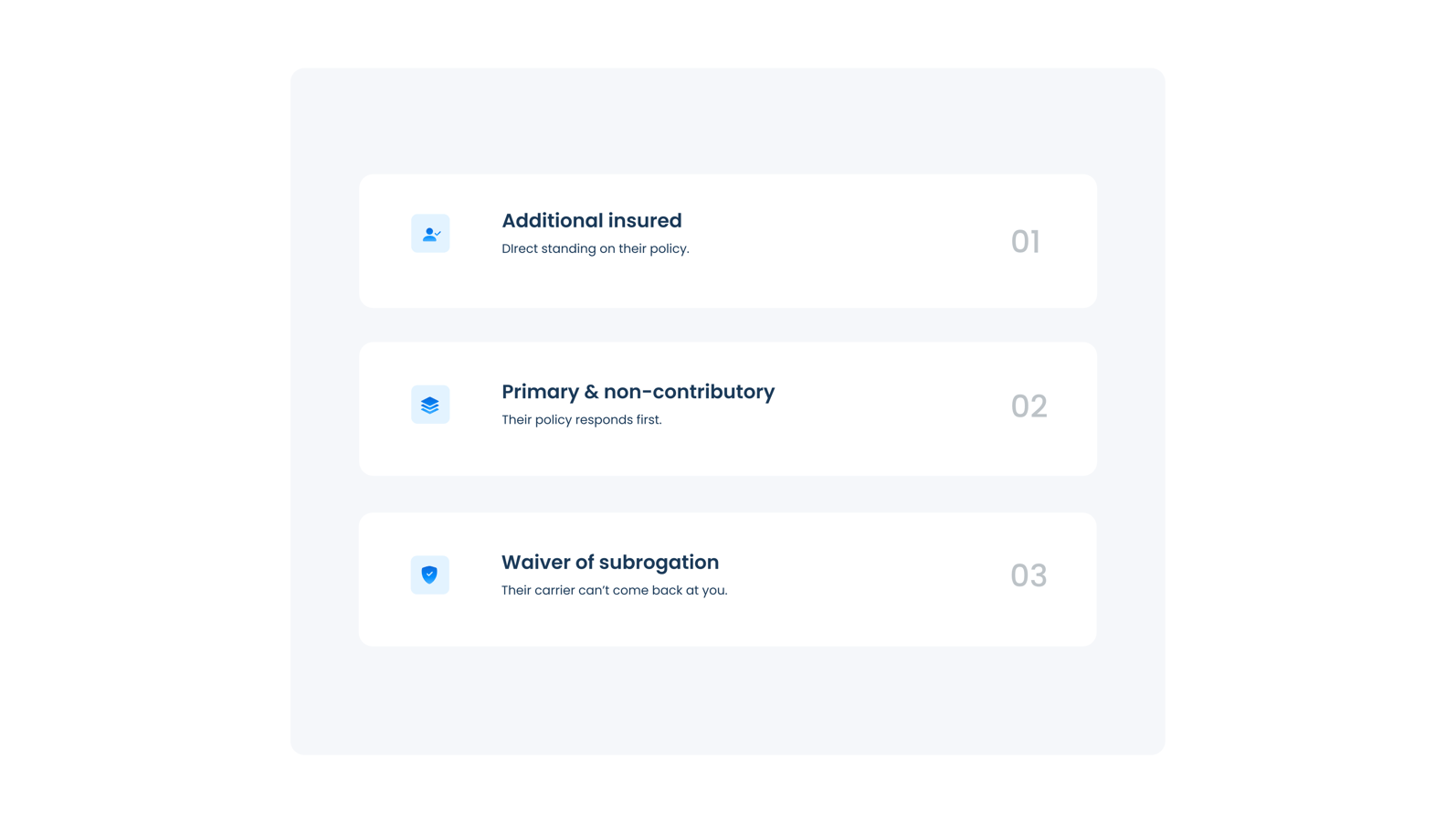
That protection comes from endorsements. Three endorsements belong in every subcontractor contract. Without all three, the risk transfer your contract is designed to create may not hold when a claim happens.
The three endorsements to require
Additional insured endorsement
An additional insured endorsement gives you direct standing on the subcontractor's general liability policy. When a claim arises from their work, you go directly to their carrier rather than relying on the indemnification clause in the contract.
Require two forms. CG 20 10 covers your additional insured status while the sub is actively working. CG 20 37 extends that coverage to liability arising after the work is complete. Both are required because completed operations claims, construction defects, post-project injuries, or property damage often surface years after a project closes.
The certificate has a checkbox for additional insured status. A checked box only confirms the notation was requested. The endorsement document is the only confirmation the coverage exists on the policy.
For a full breakdown of forms and what to verify, see Additional Insured Endorsements: What You Need to Know.
Primary and non-contributory endorsement
Without primary and non-contributory language, a subcontractor's carrier can invoke other insurance clauses and require your general liability policy to share in a covered loss. Your policy gets pulled into a claim that should have stayed entirely with the sub's carrier.
Primary means the sub's policy responds before yours. Non-contributory means their carrier cannot require your policy to contribute. Both terms must appear on the endorsement. A policy can be primary without being non-contributory so you should confirm both explicitly.
This endorsement has to be added to the sub's policy separately. The certificate checkbox is not confirmation it exists.
For a full breakdown, see Primary and Non-Contributory: What It Means and Why It Matters.
Waiver of subrogation
After a subcontractor's carrier pays a claim, it has the right to pursue recovery against whoever caused the loss. Without a waiver of subrogation, that carrier can come after you even if you were named as an additional insured and the claim was already resolved.
Require the waiver on both the general liability policy and the workers compensation policy. Workers comp subrogation actions against hiring parties are common on construction projects and are often overlooked. The GL waiver alone is not sufficient.
An indemnification clause in the contract does not substitute for this endorsement. The indemnification binds the subcontractor. The waiver binds the carrier. They are separate protections.
For a full breakdown, see Waiver of Subrogation: What It Is and Why Contracts Require It.
What to verify on each endorsement
Collecting the endorsement document is the first step. Verifying it covers what the contract requires is the actual work.
For each endorsement, confirm:
The endorsement document exists separately from the certificate. The certificate notation is not verification. Request the endorsement page directly.
The form number matches what the contract specifies. Brokers attach whatever is easiest to issue if the contract does not specify form numbers. CG 20 10, CG 20 37, and the relevant primary and non-contributory and waiver forms should be named explicitly in every subcontract.
Completed operations coverage remains active through the tail period. CG 20 37 and the waiver of subrogation need to stay in force for the full tail period defined in the contract, often two to five years after project completion. Track these separately from active project COIs.
How to track completed operations endorsements at renewal.
Blanket endorsements are reviewed, not just accepted. Some carriers issue blanket endorsements that cover any party required by contract. These can work, but the wording varies. Some are limited to ongoing operations or include carve-outs that reduce coverage. Review the language, not just the form type.
These requirements should flow down to every tier. For clause language to include and how to collect from lower-tier subs, see Sub-Tier Subcontractor COI Compliance: A Guide for GCs.
How PINS enforces your requirements
Knowing what to require is the easy part. Verifying that every subcontractor actually provides it at submission is where most processes fall apart.
PINS collects endorsement documents alongside certificates as part of the standard submission workflow. The AI Assistant reviews endorsement language against your contract requirements and calls out issues such as missing completed operations coverage, wrong form numbers, and blanket endorsements that do not meet contract specs. Your team reviews the summary and makes the final call. Nothing is auto-approved.
General contractors managing endorsement requirements across a subcontractor roster can see how GC teams structure this in COI tracking software.
Frequently asked questions
What endorsements should every subcontractor provide?
At minimum, three endorsements belong in every subcontractor contract: an additional insured endorsement covering both ongoing operations (CG 20 10) and completed operations (CG 20 37), primary and non-contributory language on the general liability policy, and waiver of subrogation on both the GL and workers compensation policies. Each requires a separate endorsement document. The certificate of insurance alone does not confirm any of these are in place.
Does a certificate of insurance confirm endorsements are in place?
No. The ACORD 25 has checkboxes for additional insured status, primary and non-contributory, and waiver of subrogation. A checked box confirms the notation was requested, not that the endorsement exists on the policy. The only confirmation is the endorsement document itself. Always collect and review the endorsement alongside the certificate.
What is the difference between CG 20 10 and CG 20 37?
CG 20 10 covers additional insured status while the subcontractor is actively working. CG 20 37 extends that coverage to liability arising from completed work after the project closes. Requiring only CG 20 10 leaves no additional insured protection for post-completion claims, which include construction defects and completed work injuries. Both forms are required for complete coverage.
Why does waiver of subrogation need to cover workers compensation?
A GL waiver prevents the sub's general liability carrier from pursuing recovery against you. A workers comp waiver prevents the workers comp carrier from doing the same. Workers comp subrogation actions against hiring parties and property owners are common on construction projects. Requiring a GL waiver without a workers comp waiver leaves a gap that surfaces when a workers comp claim occurs.
What happens if a subcontractor cannot provide the required endorsements?
If a subcontractor cannot meet a specific endorsement requirement, your team needs to decide whether to proceed and document the exception, or hold the sub until the requirement is met. Any exception should be documented in your compliance program with a timestamp and a reason. Undocumented exceptions create audit gaps and complicate claims if the coverage in question was the one that was missing.