Last updated: September 19, 2026
Public agencies manage insurance compliance differently than private organizations. The vendor base is broader, requirements are set by contract and policy rather than preference, and procurement and legal teams are involved in compliance decisions.
The stakes reflect that reality. A lapsed COI on a public works project creates liability exposure for the agency and the public it serves. A missing endorsement on a vendor contract can compromise the agency's ability to recover losses from a claim. These risks surface in claims, audits, and litigation against public entities regularly.
Who this applies to
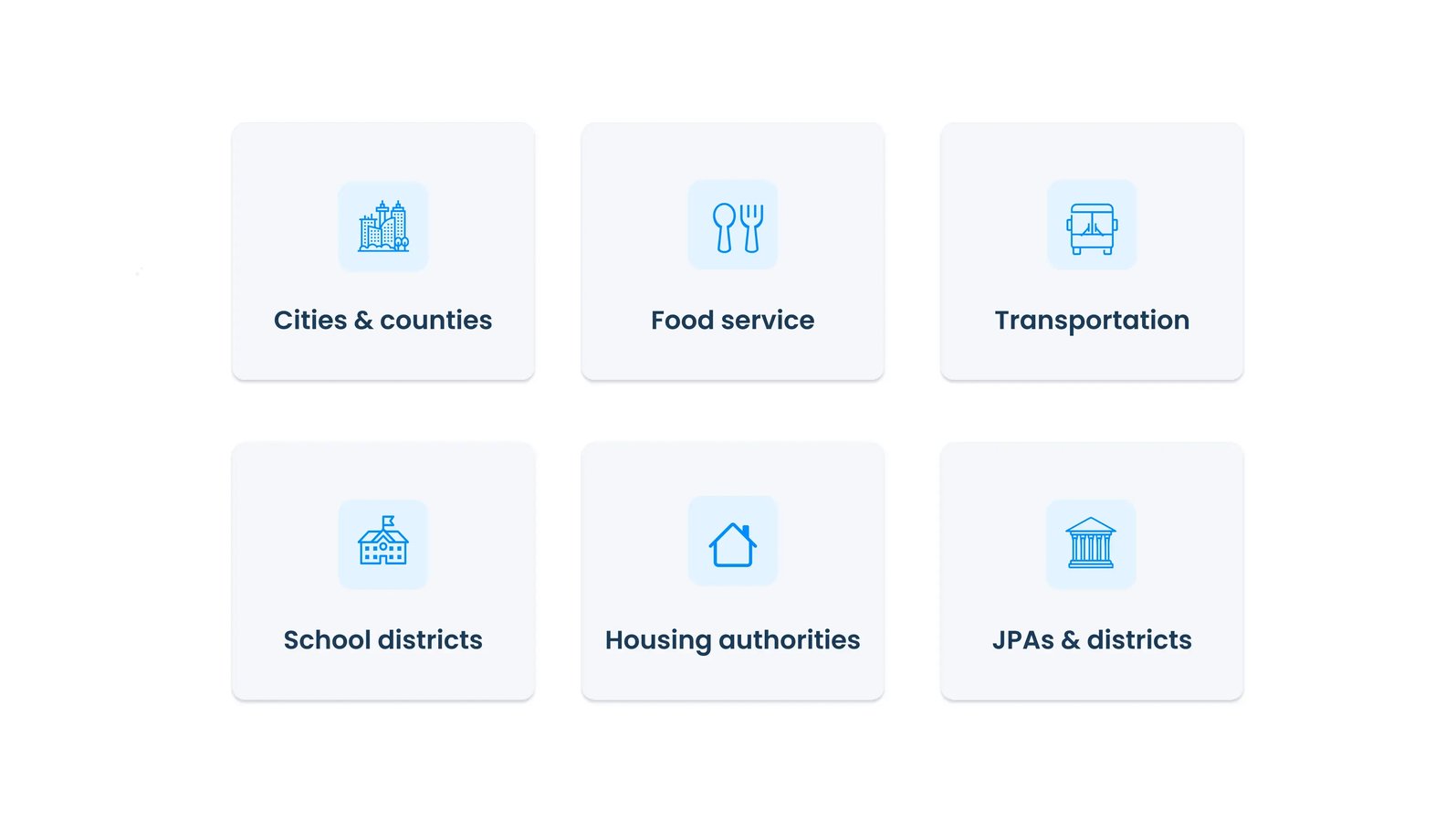
The COI tracking challenges covered here apply across the full range of public agency types: cities and counties managing vendor, contractor, and service provider relationships; JPAs and special districts with complex multi-party contracting structures; school districts and community college districts managing construction projects, food service vendors, transportation providers, and facility contractors; transit agencies with large contractor and operator bases; housing authorities managing property maintenance and construction vendors; and any public entity that contracts with third parties and requires proof of insurance as a condition of the contract.
The vendor base and contract types vary. The core compliance requirements do not: collect the certificate, verify the coverage, confirm the endorsements, and track everything through the end of the contract term.
What public agencies need to collect
Certificate of insurance (ACORD 25)
Every vendor and contractor working under a public agency contract should provide a current ACORD 25 certificate before work begins. The certificate shows what policies are in place, who is insured, what the limits are, and when coverage expires.
The certificate alone is not sufficient for compliance verification. It only confirms what coverage was in place when it was issued.
Additional insured endorsement
Public agencies should be named as additional insured on the general liability policy of every vendor and contractor under contract. This gives the agency direct standing on the vendor's policy if a claim arises from their work.
Require CG 20 10 for ongoing operations and CG 20 37 for completed operations. Both are needed. Public works projects, facility construction, and infrastructure contracts frequently produce post-completion claims that CG 20 10 does not cover.
The certificate checkbox for additional insured status is not confirmation the endorsement exists. Request the endorsement document separately.
For a full breakdown of forms and what to verify, see Additional Insured Endorsements: What You Need to Know.
Primary and non-contributory language
Without this endorsement, a vendor's carrier can invoke other insurance clauses and require the agency's own coverage to share in a loss. Public agencies typically carry self-insurance programs or public entity coverage that should not be pulled into vendor claims.
Require primary and non-contributory language on the GL policy explicitly. Confirm both terms appear in the endorsement. A policy can be primary without being non-contributory.
Waiver of subrogation
After paying a claim, a vendor's carrier has the right to pursue recovery against whoever caused the loss. A waiver of subrogation prevents the carrier from coming after the agency once the claim is resolved.
Require the waiver on both the general liability and workers compensation policies. Workers comp subrogation actions against public agencies are not uncommon on construction and infrastructure projects.
Workers compensation
Confirm every contractor and subcontractor carries workers compensation coverage for their employees. A contractor without workers comp shifts that exposure to the agency on a claim.
Umbrella or excess liability
Many public agency contracts require umbrella limits above the base GL policy, particularly for construction, infrastructure, and high-liability service contracts. Confirm the umbrella is in place and follows form over the underlying GL.
How public agency compliance programs typically break down
Permitting and vendor onboarding without a tracking system
Many public agencies collect COIs at contract execution or permit issuance and never track them again. The certificate that was current when the contract started may have expired months ago. Nobody finds out until a claim surfaces or an auditor asks.
No endorsement verification
The certificate gets collected and filed. The endorsement documents are never requested. The agency has a record that a certificate was provided but no confirmation that the required endorsements are in place. This is the most common compliance gap in public agency programs.
Decentralized contracting without centralized compliance
In most public agencies, contracts originate across departments. Public works signs construction contracts. Parks and recreation contracts with event vendors. The city manager's office handles professional services. The library district manages its own vendor relationships.
Each department head may have authority to execute contracts, but rarely has the time or expertise to enforce insurance requirements consistently. Risk management sits somewhere else in the org chart and often does not see the contract until after it is signed, if at all.
The result is a compliance program that depends on whoever happens to be paying attention in each department. Some vendors get reviewed thoroughly. Others slip through. Requirements vary because no one department is applying the same standard.
A centralized COI tracking system does not eliminate decentralized contracting. It gives risk management a consistent process that applies across every department, regardless of where the contract originated. Requirements are set once and applied uniformly. Every vendor submission goes through the same review. Every approval and exception is documented.
Audit exposure from incomplete documentation
When a state auditor, an attorney, or an oversight body asks for documentation of compliance decisions, the answer should be a report. In most public agency programs, the answer is a search through email threads, shared drives, and paper files. Incomplete documentation creates audit exposure even when the underlying compliance was maintained.
Permit-based COI tracking without renewal follow-up
Agencies that issue permits often collect a COI at permit issuance and never follow up. A permit that covers a 12-month construction project may have an insurance policy that expires after six months. Without renewal tracking, the agency has no coverage for the back half of the project period.
What a well-run public agency compliance program looks like
Requirements are set at the contract or permit level, not as a blanket agency policy. Different contract types carry different risk profiles and should carry different requirements.
Every vendor and contractor submits a certificate and endorsement documents before work begins. The endorsements are reviewed against the contract requirements, not collected and filed.
Expirations are tracked and renewal requests go out ahead of the policy end date. Vendors who do not respond receive follow-up. Coverage does not lapse unnoticed.
Every approval, waiver, and exception is documented with a timestamp and a reason. When an auditor asks what was approved and when, the answer is already in the system.
The compliance record stays attached to the vendor and the contract. At renewal, the history is available without a manual search.
Why human approval matters for public agencies
Public agencies operate under public records laws, open meeting requirements, and procurement regulations that create accountability for compliance decisions. When a compliance decision is made by an automated system rather than a staff member, the accountability chain breaks.
PINS AI reads submitted documents against your requirements and tells your team what is missing and what meets the standard. Your team reviews the finding and makes the decision. PINS logs the decision under the staff member who made it, with a timestamp and the supporting documentation. That record is what holds up in an audit and what protects the agency in litigation.
Fully automated compliance decisions create an accountability gap that public agencies cannot afford.
For a full comparison of self-service versus managed models, see In-House vs Outsourced COI Tracking.
Learn more about how PINS is built for public agency COI compliance.
How PINS works for public agencies
PINS is used by public agencies to manage COI compliance across vendor and contractor relationships.
Requirements are set at the contract level. Vendors submit through a no-login upload link. The AI Assistant reads submissions against your requirements and tells your team what is missing and where. Your team reviews the finding and approves, rejects, or grants an exception. Every decision is logged.
Renewal requests go out automatically. Expired policies trigger follow-up without staff intervention. The compliance record for every vendor stays in the system and is available for audit at any time.
Book a Demo to see how PINS handles COI compliance for public agencies.
Frequently asked questions
How do public agencies track certificates of insurance?
Most public agencies collect COIs at contract execution or permit issuance and file them manually. The most common failure point is that nobody tracks expirations or follows up at renewal. A certificate that was current when the contract started may have lapsed months before anyone notices. Dedicated COI tracking software automates the renewal cycle and maintains a compliance record that holds up in audits.
What endorsements should public agencies require from contractors?
At minimum, additional insured status covering both ongoing and completed operations (CG 20 10 and CG 20 37), primary and non-contributory language on the general liability policy, and waiver of subrogation on both the GL and workers compensation policies. Each requires a separate endorsement document. The certificate of insurance does not confirm any of these are in place. For a full breakdown, see What Endorsements Should I Require from Subcontractors.
Why is audit readiness a specific concern for public agencies?
Public agencies are subject to state audits, oversight board reviews, and public records requests that private organizations are not. When a compliance decision is questioned, the agency needs to show what was required, what was submitted, what was reviewed, and who approved it. Manual compliance programs rarely have that documentation. A system that logs every decision automatically makes audit prep a report pull rather than a reconstruction.
How should public agencies handle COI requirements for permits?
Permits that authorize work on public property should include COI requirements as a condition of issuance. The certificate and endorsements should be collected before the permit is issued, not after. Track the policy expiration against the permit period and send renewal requests if the policy expires before the permit closes. A lapsed COI on an active permit means the agency has no coverage for work performed during the gap.
Can PINS handle the accountability requirements specific to public agencies?
Yes. PINS logs every compliance decision under the staff member who made it, with a timestamp and the supporting documentation. Approvals, waivers, and exceptions are all recorded. This documentation structure is specifically useful for public agencies that need to demonstrate accountability for compliance decisions to auditors, oversight bodies, or in litigation. Fully automated compliance decisions without human sign-off do not provide this accountability chain.
Does PINS work for smaller public agencies with limited staff?
Yes. PINS is designed for teams where one or two people manage COI compliance alongside other responsibilities. The automation handles collection requests, renewal follow-up, and initial document review. Your team reviews findings and makes decisions. The chasing and manual reading are gone.