Last updated: October 22, 2026
Sub-tier compliance means confirming that your subcontractors’ subcontractors carry the insurance protection your contracts require. General contractors handle it two ways: flow-down clauses that pass insurance requirements through every subcontract, and certificates of insurance and endorsements collected from lower-tier subs before they start work.
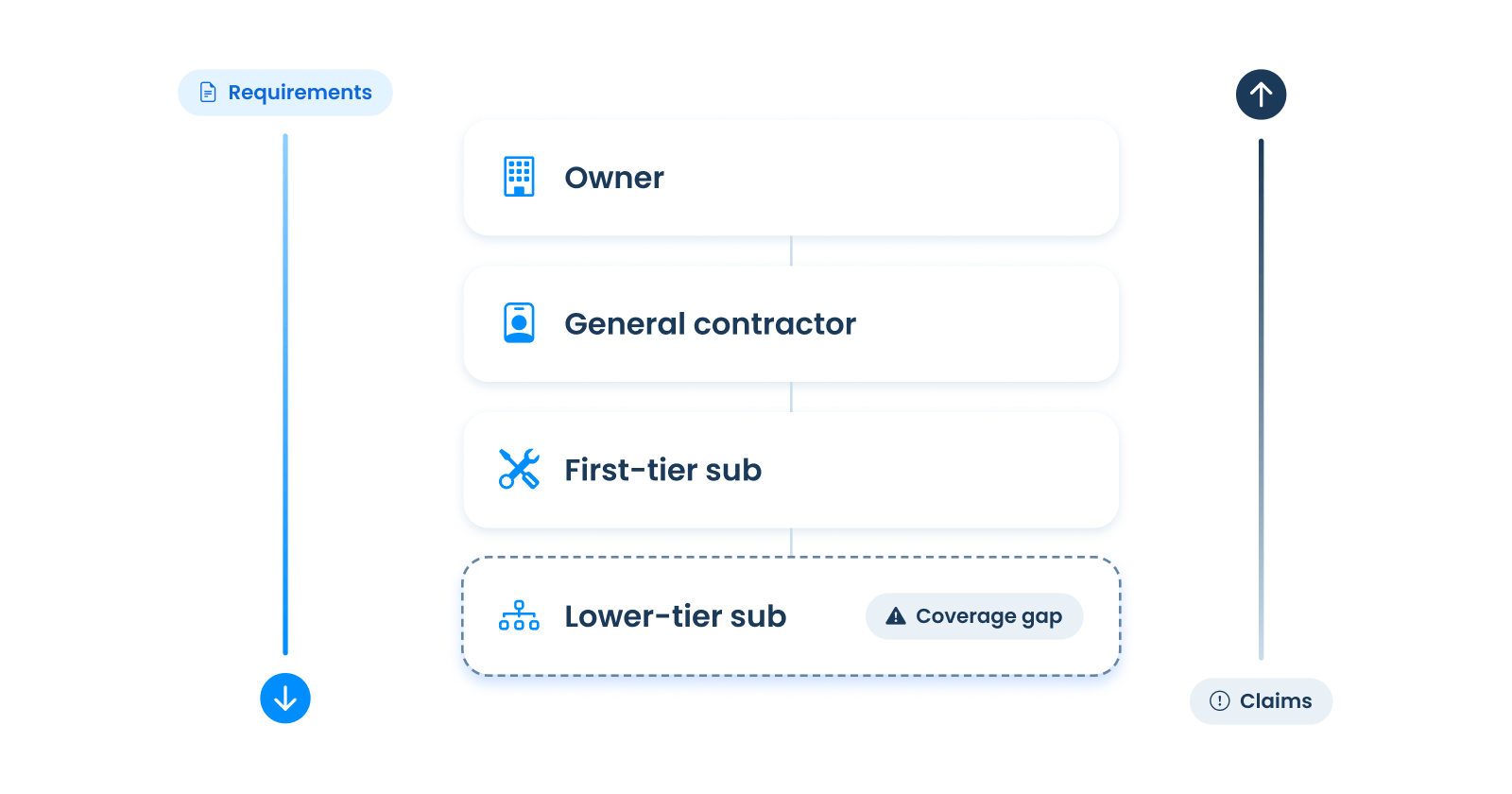
Most COI programs stop at the first tier. The GC collects certificates from the subs it hired directly and assumes those subs handled their own. That assumption holds until a sub-sub’s employee gets hurt, the sub-sub’s coverage turns out to be missing or worded wrong, and the claim moves up the chain.
Why lower-tier coverage becomes your problem
Liability on a construction project follows the work. When a lower-tier sub causes a loss, the claim usually names everyone above it: the first-tier sub, the GC, and the owner.
If the sub-sub carries the right coverage and the right endorsements, its carrier responds first. If it does not, the claim looks for the next policy up the chain. That is often the first-tier sub’s policy, and then yours.
Workers compensation adds another layer. In most states, a contractor can be responsible for workers compensation benefits owed to employees of an uninsured subcontractor. That is why every contractor in the chain needs proof that the subs below it carry coverage. Uninsured sub payroll can also be added to a contractor’s premium at audit. For how that works, see How COI Tracking Protects You in a Workers Comp Audit.
Documentation matters here too. Some states do not hold a contractor liable if it required the sub to carry workers compensation and relied in good faith on evidence that the coverage was in force. A written contract requirement plus a valid certificate of insurance is the kind of record that supports that defense.
The direct contract problem with additional insured endorsements
This is where most sub-tier programs break down. Many blanket additional insured endorsements only reach the party the named insured has a written contract with.
ISO form CG 20 33 is the common example. It extends additional insured status to the party the named insured has a written construction agreement with. A sub-sub’s contract is with the first-tier sub, not with you. Under CG 20 33, the first-tier sub is covered. The GC and the owner above it are not.
ISO form CG 20 38 was added in 2013 for this situation. It extends additional insured status to other owners, lessees, or contractors the named insured is required to add, with no direct contract needed. The requirement has to be in the sub-sub’s own written contract, which is why the flow-down clause matters. CG 20 38 covers ongoing operations only.
Completed operations have their own pair of automatic forms, introduced in 2019. CG 20 39 reaches only the party the named insured contracted with, like CG 20 33. CG 20 40 reaches upstream parties, like CG 20 38. Carriers also issue proprietary blanket forms with their own wording.
The practical rule: when you review a lower-tier sub’s additional insured endorsements, confirm the wording reaches your organization for both ongoing and completed operations, even though you never signed a contract with that sub. For more on the core additional insured forms, see Additional Insured Endorsements: CG 20 10 and CG 20 37 Explained.
What a flow-down insurance clause should require
Pass-through requirements start in your subcontract. The exact language belongs with your counsel and insurance advisor, but most flow-down insurance clauses cover the same points:
- The subcontractor includes insurance requirements at least as broad as its own in every lower-tier subcontract.
- Each lower-tier subcontract requires the sub-sub to add the GC, the owner, and any other parties listed in the prime contract as additional insureds, for ongoing and completed operations.
- Primary and non-contributory language applies to the general liability coverage at every tier.
- Waivers of subrogation apply at every tier where allowed. Several states bar or restrict waivers on workers compensation, so the clause should account for project location.
- The subcontractor collects certificates and endorsements from its lower-tier subs before they start work and provides them on request.
- The subcontractor remains responsible if a lower-tier sub is uninsured or underinsured.
Keep lower-tier requirements realistic. The further down the chain a sub sits, the less bargaining power it usually has, and smaller subs can struggle to get some coverages, such as completed operations additional insured status. Requirements should be reasonable and obtainable for the scope. If your program allows lower limits for smaller sub-subs, write those limits into the clause so there is no debate later about what was required.
For the endorsements every tier should carry, see What Endorsements Should I Require from Subcontractors?
Delegated collection vs. direct collection
Once the requirements are in the contract, someone has to collect and review the documents. There are two models.
Delegated collection
The first-tier sub collects certificates from its own subs and forwards them, or certifies that its subs are compliant. This keeps the GC’s workload down. The tradeoff is control. You are relying on the sub’s review process, and most subs do not have a dedicated person checking endorsement wording.
Direct collection
The GC requests and reviews lower-tier documents itself, the same way it handles first-tier subs. This gives you one review standard and one audit record. The tradeoff is volume. Once you count specialty trades, equipment operators, and haulers, a single project can add dozens of lower-tier subs.
The middle path most teams land on
Many GCs require direct collection for any lower-tier sub that performs on-site work and accept delegated collection or a written certification for off-site suppliers. The higher the risk of the scope, the closer the GC wants to be to the documents.
Managing requirements across multiple entities
Sub-tier compliance gets harder when the prime contract requires several parties to be covered. An owner may require its parent company, its lender, its property manager, and the architect to be named as additional insureds alongside the GC.
Every one of those parties has to flow down. If a lower-tier endorsement names the GC but misses the owner’s lender, the project carries compliance exposure even though the certificate looks complete.
Keep a written list of required additional insured parties for each project and check every tier’s endorsement against that project’s list. The same subcontractor can need different named parties on different projects. For how commercial GCs handle requirement variation by project, see COI Tracking for Commercial General Contractors.
A note on wrap-up programs
On projects with an owner or contractor controlled insurance program (OCIP or CCIP), enrolled subs in any tier are covered for on-site general liability and workers compensation under the wrap-up. Lower-tier tracking still matters. Subs still provide their own off-site general liability and workers compensation, auto, and contractors equipment coverage, plus professional and pollution coverage unless the program includes them. Smaller subs, off-site fabricators, and suppliers are often not enrolled at all.
Completed operations coverage under a wrap-up also ends. The extension is most often three, five, or seven years. After that, each sub’s own general liability and umbrella policies have to respond, so their coverage still matters long after the project closes.
What to verify for every lower-tier sub
- A certificate of insurance showing general liability, auto, and workers compensation, with limits that meet the flow-down requirement
- Additional insured endorsements whose wording reaches the GC, the owner, and every other required party, for both ongoing and completed operations (CG 20 38 and CG 20 40 or equivalent wording, not direct-contract-only forms)
- Primary and non-contributory language on the general liability policy
- Waiver of subrogation on general liability and, where state law allows, workers compensation
- Policy dates that cover the full time the sub is on site, with renewals collected before expiration
How PINS supports sub-tier compliance
PINS reads your contract and builds the insurance requirements for you. Your team can review and edit them at any time. Requirements can be set at the project, contract, or vendor level, so each project’s additional insured list and limits apply to the documents submitted for that project.
Lower-tier subs are set up as their own records, with a naming and numbering structure that shows they are sub-tier and which first-tier sub they work under. Each one gets its own requirements, document review, and expiration tracking, and vendors at every tier upload documents through a secure link with no login required.
The PINS AI Assistant reads the actual endorsement wording and checks it against your requirements. Teams can set custom questions that identify direct-contract-only language, so an endorsement that only covers the party the sub-sub contracted with is caught before anyone accepts it. Your team reviews each finding and makes the call. Nothing is auto-approved.
Every approval, rejection, waiver, and exception is logged. When an owner asks for proof that lower-tier subs were covered, the record is already there. For GCs running Procore, commitments flow into PINS and compliance status shows inside Procore. See PINS for Procore.
For a broader look at construction compliance, see COI tracking for construction and COI Tracking for Heavy Civil Contractors.
For a full list of questions to ask any COI tracking software vendor before you buy, download the COI Tracking Software Evaluation Checklist.
Frequently asked questions
What is sub-tier subcontractor compliance?
Sub-tier compliance is the process of confirming that lower-tier subcontractors, the subs hired by your subs, carry the insurance your contracts require. It relies on flow-down clauses that pass insurance requirements through every subcontract, plus collection and review of certificates of insurance and endorsements from those lower-tier subs. Without it, a sub-sub’s missing or narrow coverage can move a claim up the chain to the first-tier sub, the GC, and the owner.
Does a CG 20 33 endorsement cover the general contractor for a sub-subcontractor’s work?
No. CG 20 33 extends additional insured status only to the party the named insured has a written construction agreement with, which for a sub-sub is the first-tier subcontractor. The GC and owner above that sub are outside its reach. ISO form CG 20 38 extends ongoing operations coverage to those upstream parties, and CG 20 40 does the same for completed operations, as long as the sub-sub’s own contract requires them to be added.
Who is responsible for collecting certificates from lower-tier subcontractors?
That depends on how your subcontract is written. Under delegated collection, the first-tier sub collects and forwards lower-tier certificates or certifies compliance. Under direct collection, the GC requests and reviews those documents itself. Many GCs use direct collection for lower-tier subs working on site and delegated collection for off-site suppliers.
What should a flow-down insurance clause require?
A flow-down clause should require the subcontractor to include insurance requirements at least as broad as its own in every lower-tier subcontract. It should require lower-tier subs to add the GC, owner, and other listed parties as additional insureds, with primary and non-contributory language on general liability and waivers of subrogation where state law allows them. It should also require the sub to collect lower-tier certificates and endorsements before work starts and keep the sub responsible if a lower-tier sub is uninsured. Have counsel and your insurance advisor review the final wording.
Can a general contractor be liable for a sub-subcontractor’s uninsured workers?
In most states, a contractor can be responsible for workers compensation benefits owed to employees of an uninsured subcontractor. Some states do not hold the contractor liable if it required coverage in writing and relied in good faith on evidence that the coverage was in force. Collecting and tracking workers compensation certificates at every tier is the most direct way to reduce that exposure and document your good faith.