Last updated: November 2, 2026
ISO publishes more than a dozen additional insured endorsements, each written for a different relationship. CG 20 10 and CG 20 37 cover owners and contractors on construction work. CG 20 11 covers landlords. CG 20 12 covers agencies that issue permits. CG 20 15 covers product vendors. CG 20 18 covers lenders. CG 20 26 is the catchall when nothing else fits. Blanket forms such as CG 20 38 and CG 20 40 add parties automatically when a written contract requires it.
The wrong form can look fine on the certificate and still leave the additional insured without coverage for the claim that matters. This guide covers the forms beyond CG 20 10 and CG 20 37. For those two, see CG 20 10 and CG 20 37: Additional Insured Forms Explained.
Jump to: Form comparison · CG 20 11 and CG 20 18 · CG 20 12 · CG 20 15 · CG 20 26 · Blanket forms · How to tell which form you received · FAQ
Which additional insured form fits which relationship
| Form | Protects | Use it when | Completed ops? |
|---|---|---|---|
| CG 20 11 | Landlords and property managers | A tenant leases space and the lease requires the landlord or manager to be added | No |
| CG 20 12 | State and local government agencies | The agency issued a permit or authorization, but the work is not being done for the agency | No |
| CG 20 15 | Vendors that sell or distribute your products | A distributor or retailer requires protection for products it resells | Products only |
| CG 20 18 | Mortgagees, assignees, and receivers | A lender requires protection on the property owner's liability policy | No |
| CG 20 26 | Any designated person or organization | No more specific form fits, such as license agreements and some permits | No |
| CG 20 33 / 20 38 | Owners and upstream contractors, automatically | A contractor needs blanket coverage for parties its contracts require | No |
| CG 20 39 / 20 40 | Owners and upstream contractors, automatically | The same blanket approach, after the work is done | Yes |
| CG 20 07 / 20 32 | Architects, engineers, and surveyors | A contract requires a design professional to be added for jobsite liability. CG 20 07 applies to design professionals the contractor hires; CG 20 32 to scheduled ones hired by others. | No |
| CG 20 28 / 20 34 | Equipment lessors | An equipment rental agreement requires the lessor to be added. CG 20 28 is scheduled; CG 20 34 is automatic. Coverage ends when the lease does. | No |
Premises and property forms
CG 20 11: Additional Insured, Managers or Lessors of Premises
CG 20 11 is the standard landlord form. It adds the landlord or property manager named in the schedule to the tenant's general liability policy for liability arising out of the ownership, maintenance, or use of the part of the premises leased to the tenant.
Coverage does not apply to occurrences after the tenant moves out, or to structural alterations, new construction, or demolition performed by or for the landlord. Because coverage is tied to the leased space, claims in common areas such as parking lots and lobbies are a frequent source of dispute. For tenant and vendor tracking, see COI Tracking for Property Managers.
CG 20 18: Additional Insured, Mortgagee, Assignee, or Receiver
CG 20 18 protects a lender, assignee, or receiver named in the schedule on the property owner's liability policy, only for liability in that role arising out of the named insured's ownership, maintenance, or use of the scheduled premises. Like CG 20 11, it excludes structural alterations, new construction, and demolition. It is a property ownership form and should not appear in place of CG 20 10 on a contractor's submission.
Government and permit forms
CG 20 12: Additional Insured, State or Governmental Agency or Subdivision or Political Subdivision, Permits or Authorizations
Cities, counties, and state agencies issue permits for street work, utility cuts, sidewalk use, special events, and filming. CG 20 12 adds the issuing agency as an additional insured for liability arising out of the operations the permit or authorization covers.
It covers ongoing operations only. It is also the wrong form when the contractor is performing work for the agency under a contract. In that case, the agency should require CG 20 10 and CG 20 37. Some agencies prefer CG 20 26 for authorizations that are not formally called permits. For how agencies set requirements by contract type, see COI Tracking for Public Agencies.
Product forms
CG 20 15: Additional Insured, Vendors
CG 20 15 is written for manufacturers and suppliers. It adds a scheduled distributor or retailer as an additional insured for bodily injury or property damage arising out of the named insured's products that the vendor sells in the regular course of its business.
Coverage generally does not apply when the vendor repackages, relabels, or changes the product, or installs, services, or repairs it away from its own premises. It also does not apply to injury caused solely by the vendor's own negligence. CG 20 15 rarely belongs on a construction submission. If a subcontractor provides it in place of an owners and contractors form, it protects the wrong party for the wrong exposure.
The catchall form
CG 20 26: Additional Insured, Designated Person or Organization
CG 20 26 is the general purpose form for when no more specific endorsement fits. It covers the designated party for injury or damage caused, in whole or in part, by the named insured in the performance of its ongoing operations or in connection with its premises.
Many public agencies accept it for license agreements, facility use, and authorizations. It is not a substitute for CG 20 10 when the contractor is performing work for the additional insured, and it does not provide completed operations coverage.
Blanket owners and contractors forms
Blanket, or automatic, forms add any party the named insured is required to add by written contract, so nobody has to be listed by name. They differ in who they reach and which operations they cover.
- CG 20 33: ongoing operations, only for parties the named insured has a direct written contract with.
- CG 20 38: ongoing operations, also reaching other parties the contract requires, such as the project owner above the general contractor.
- CG 20 39: completed operations counterpart to CG 20 33. Introduced in 2019.
- CG 20 40: completed operations counterpart to CG 20 38. Introduced in 2019.
Which blanket additional insured endorsement reaches the furthest?
For a subcontractor's policy, the broadest standard ISO combination is CG 20 38 for ongoing operations paired with CG 20 40 for completed operations. Together they reach the general contractor, the project owner, and any other party the subcontract requires the sub to add, whether or not that party signed a contract with the sub.
CG 20 33 and CG 20 39 reach only parties with a direct written contract with the sub. On a typical project, that means the general contractor is covered and the owner is not, so the owner's tender to the sub's carrier can be denied even though the subcontract required coverage.
Two cautions apply to any blanket form. Coverage applies only to the extent the written contract requires, so vague contract language produces vague coverage. And carrier-specific blanket forms vary: some reach only direct contract parties or cover ongoing operations only. Read the wording. For how this plays out below the first tier, see Sub-Tier Subcontractor COI Compliance.
How to tell which form you received
The ACORD 25 only shows a checkbox for additional insured status. To know which form is in place, open the endorsement itself. For a field by field walkthrough of the certificate, see How to Read a Certificate of Insurance.
- Form number and edition date: printed at the bottom of the page, for example CG 20 38 12 19. The last four digits are the month and year of the edition.
- Title: printed at the top. It tells you which relationship the form was written for.
- Schedule or blanket wording: a scheduled form lists the additional insured by name. A blanket form says something like "where required by written contract" instead.
- Policy number: should match the general liability policy on the certificate.
Then confirm the form fits the relationship and covers completed operations when the contract requires it. Current ISO forms also limit coverage to injury caused, in whole or in part, by the named insured and cap the additional insured's limit at the lesser of the policy limit or the contract requirement, so contract language matters as much as the form. Most requirements also call for primary and non-contributory wording (CG 20 01) and a waiver of subrogation (CG 24 04). For the full construction checklist, see What Endorsements Should I Require from Subcontractors?
How PINS reviews additional insured forms
In PINS, your team sets the endorsement requirements for each vendor type or risk profile in a requirement template, including which additional insured forms are acceptable. Vendors and brokers upload certificates and endorsements through a secure link with no login required.
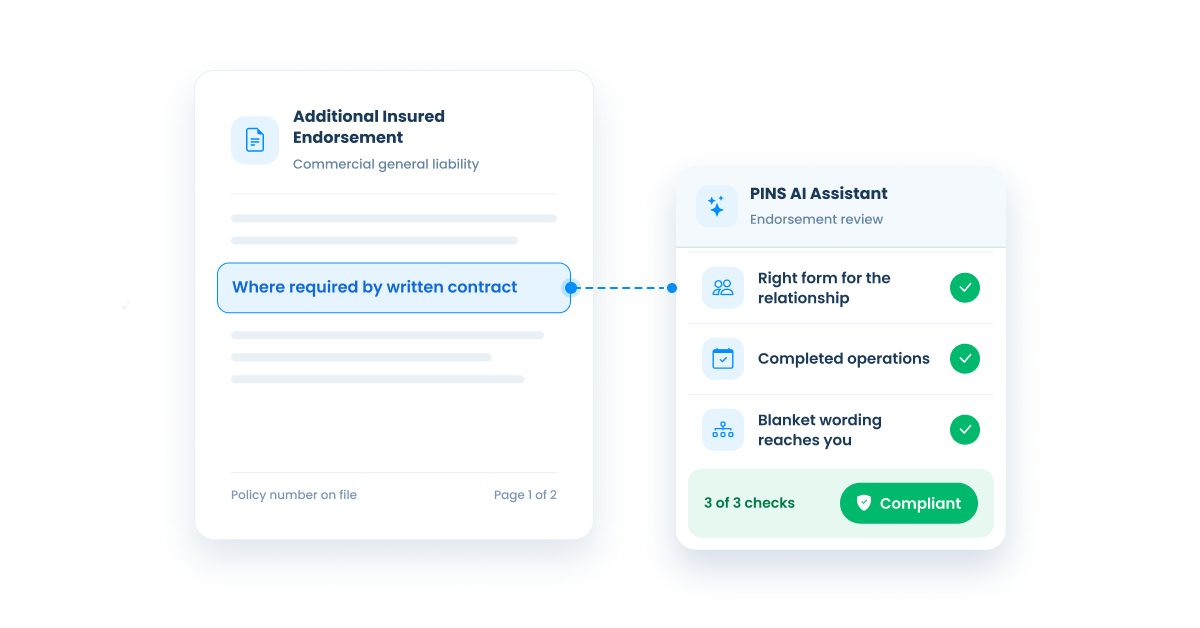
The PINS AI Assistant reads each endorsement against those requirements and identifies issues such as the wrong form for the relationship, missing completed operations coverage, or blanket wording that does not reach your organization. It shows its reasoning and links to the page it read. Your team makes the final compliance decision, and every approval, waiver, and exception is logged for audits.
Frequently asked questions
What is the best blanket additional insured endorsement for subcontractors?
Among standard ISO forms, CG 20 38 for ongoing operations paired with CG 20 40 for completed operations is the broadest combination. Both reach parties the subcontract requires the sub to add even without a direct contract, such as the project owner, while CG 20 33 and CG 20 39 reach only direct contract parties.
What is the CG 20 11 endorsement?
CG 20 11, Additional Insured, Managers or Lessors of Premises, adds a landlord or property manager to a tenant's general liability policy for liability arising out of the leased premises. It does not cover occurrences after the tenant leaves or construction work performed by or for the landlord.
What is the CG 20 12 endorsement used for?
CG 20 12 adds a state or local government agency as an additional insured when it has issued a permit or authorization for the named insured's operations. It covers ongoing operations only and is not intended for work performed for the agency, where CG 20 10 and CG 20 37 are the usual requirement.
What does the CG 20 15 vendors endorsement cover?
CG 20 15 adds a distributor or retailer as an additional insured for injury or damage arising out of the named insured's products that the vendor sells. It excludes repackaging, relabeling, product changes, most off-premises installation and servicing, and injury caused solely by the vendor's own negligence.
What is the CG 20 18 endorsement?
CG 20 18, Additional Insured, Mortgagee, Assignee, or Receiver, adds a lender or similar party to a property owner's liability policy. Coverage applies only to liability in that role arising out of the scheduled premises.
What is the difference between CG 20 26 and CG 20 10?
CG 20 10 is written for owners, lessees, and contractors when the named insured is performing operations for them. CG 20 26 is a catchall for a designated party when no more specific form applies, and it should not replace CG 20 10 for construction work done for the additional insured.
Is CG 25 03 an additional insured endorsement?
No. CG 25 03, Designated Construction Project(s) General Aggregate Limit, gives each designated project its own general aggregate limit. It is often required alongside additional insured endorsements so that claims on other jobs do not reduce the limit available on your project.